
Ceiling cassette aircon cleaning Singapore is a different job from wall-mounted servicing, even though contractors quote it the same way. Layout, failure points, and access all change. This blog will walk you through what makes cassette cleaning different, what should be in the scope, and what 2026 pricing looks like for ceiling cassette aircon cleaning in commercial and residential spaces.
Why cassette units aren’t just wall-mounted aircons on the ceiling
A wall-mounted aircon and a ceiling cassette share the same basic refrigerant cycle, but almost nothing else about the indoor unit is the same. Treating them as equivalent is why office cassettes leak water onto desks at 3pm and why retail units develop persistent smells that no general cleaning fixes. Five mechanical differences matter for cleaning.
Mounting position
Cassettes sit recessed into a false ceiling, with only the white grille panel visible below. The body of the unit lives above the ceiling tiles, suspended by threaded rods. Servicing requires platform or ladder access, often with two technicians for safety.
Airflow geometry
A 4-way cassette pushes cooled air in four directions through motorised louvres, which means more vanes to clean and more places for dust to coat. Wall-mounted units have a single horizontal louvre.
Blower wheel design
Cassettes use a centrifugal turbo fan that draws air upward through the centre and pushes it outward through the coil. Wall-mounted units use a cross-flow tangential fan. The centrifugal wheel is harder to access and accumulates dust unevenly across its blades, causing imbalance and vibration over time.
Condensate drainage
This is the big one. Most cassettes have a built-in condensate pump because the drain line runs horizontally above the ceiling, not downward by gravity. Wall-mounted units rely on gravity through a sloped drain pipe. A condensate pump is a moving part with a float switch and a small motor, both of which fail.
Filter access
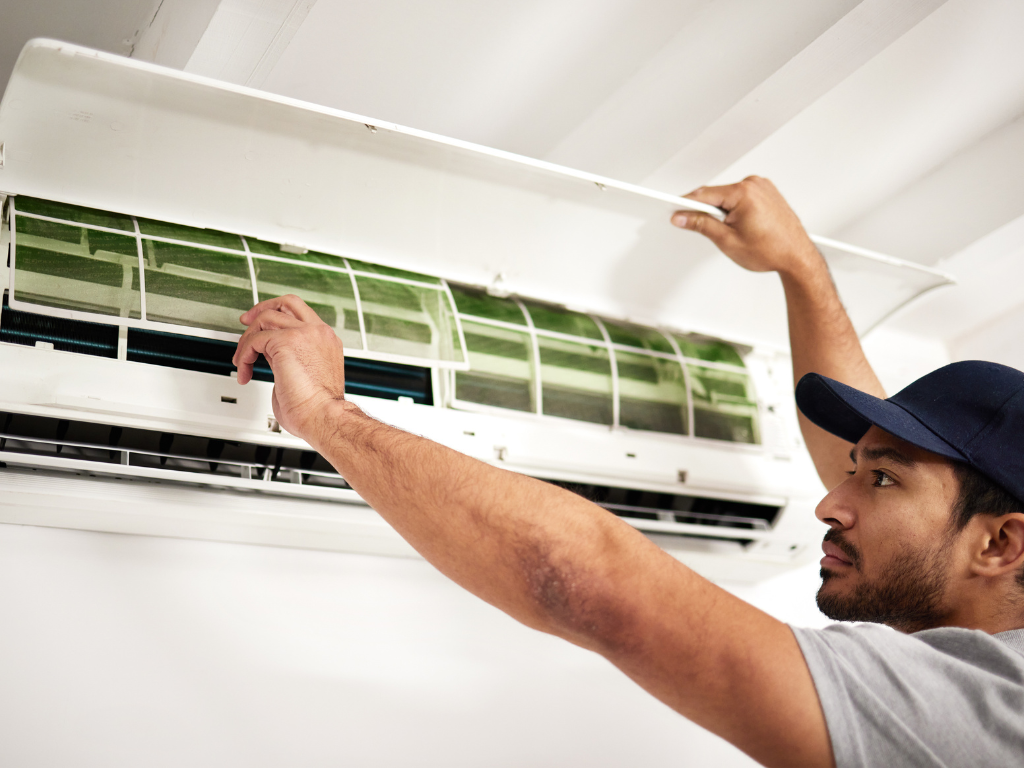
Cassettes have one large mesh filter behind the central grille, accessed by lowering the grille on hinges. Wall-mounted units have flip-up filters that are quicker to inspect.
What a proper ceiling cassette cleaning service includes
A serious cassette cleaning visit has more line items than a wall-mounted one. A correct scope of work looks like this. The grille panel is lowered and secured. Filter removed and washed in soapy water, then air-dried. The technician inspects the evaporator coil through the open grille bay, then accesses the drain pan and condensate pump from above (this is where false ceiling access matters). The pump strainer is checked for slime and biofilm. Drain pan is wiped or flushed depending on build-up. Coil surfaces get foam coil cleaner for non-dismantle, or a full chemical wash if the unit is choked.
For deeper work, the blower wheel needs removal. This requires partial dismantling of the unit from its mounting cradle, which typically means dropping the entire cassette body 20 to 30 centimetres on safety chains to gain access. The wheel is removed, soaked in cleaning solution, brushed clean of dust caked between blades, then reinstalled. Skipping this step is why cassettes still vibrate and underperform after a “full service” that wasn’t really full. The level of dismantling determines whether this is general cassette chemical cleaning or a proper chemical wash for choked aircon units. Most office cassettes need a full chemical wash every 12 to 18 months on top of regular servicing.
The condensate pump: a cassette-specific failure point
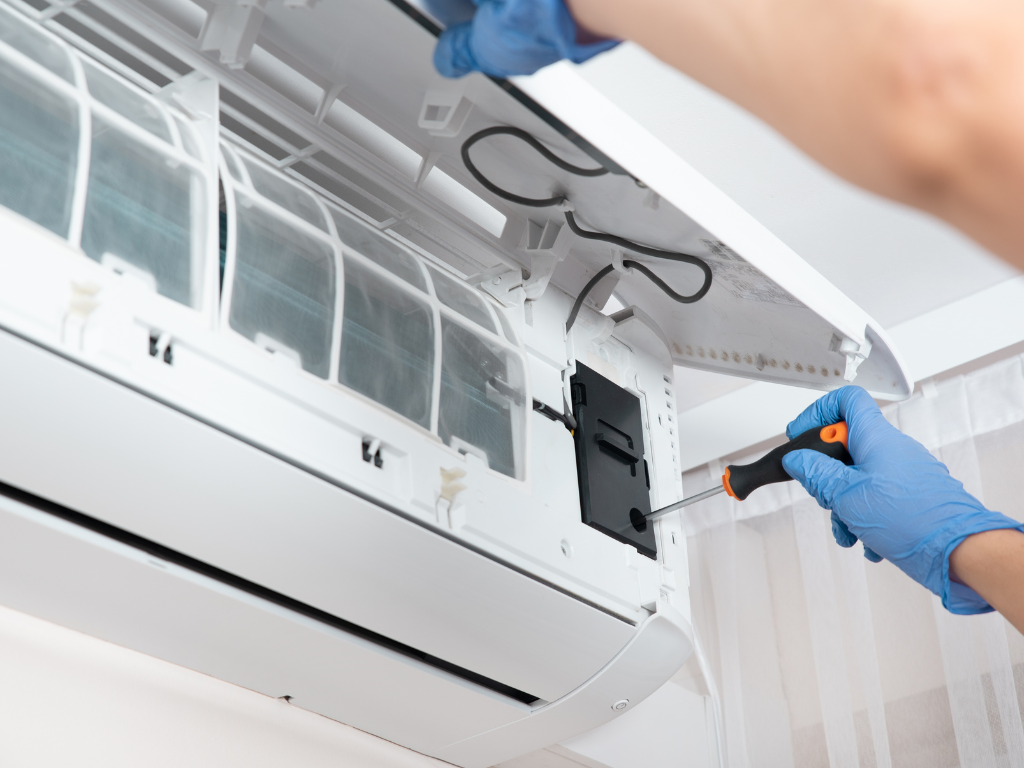
Wall-mounted units don’t have this part. Cassettes do. A condensate pump fails in two ways: the float switch jams (water keeps rising, pump never triggers, water overflows), or the small motor seizes (pump triggers but moves nothing). Symptoms are obvious. Water drips from the corners of the cassette grille, ceiling tiles stain brown around the unit, and in bad cases the false ceiling collapses under accumulated water weight. By the time the water reaches the meeting room floor, you have a $200 cleaning bill, a $400 ceiling repair bill, and a $250 pump replacement.
A proper cassette servicing visit tests the pump by pouring water into the drain pan and checking that the pump triggers, runs for the expected duration, and stops cleanly. This takes five minutes. Most contractors skip it.
Drain pan biofilm: the smell that won’t go away
Cassette drain pans sit horizontally inside the unit body, often with limited drain slope. Condensate pools longer here than in a wall-mounted unit, and biofilm grows faster as a result. This biofilm is the source of the musty smell that hits office occupants when the aircon kicks in on Monday morning.
General cleaning wipes the surface of the drain pan. A chemical wash flushes it with anti-microbial solution. Only the wash actually kills the biofilm. If the smell returns within a week of cleaning, you’re looking at drain pan biofilm that needed a wash, not a wipe. The signs that an aircon needs a chemical wash in Singapore apply equally to cassettes, with smell being the most reliable indicator. For multi-cassette setups, persistent smell across multiple units usually points to a shared drain line problem. The chemical wash process explained for Singapore aircons applies to cassettes too, with adjustments for access.
Service intervals by use case
Cassette servicing intervals are tighter than residential wall-mounted because run hours are higher and access cost penalises catching problems late.
| Use case | General cleaning | Chemical wash |
| Office (9 to 11 hours, weekdays) | Every 6 to 8 weeks | Every 12 to 15 months |
| F&B and retail (12+ hours, daily) | Every 4 to 6 weeks | Every 9 to 12 months |
| Meeting rooms (light use) | Every 12 weeks | Every 18 to 24 months |
| Clinics, schools, hotels | Every 6 to 8 weeks | Every 12 months |
These intervals assume a clean ambient environment. Kitchens, hair salons, and printing rooms generate aerosolised oils, hair, or particulates that coat coils faster. Cut the interval by 30 to 50% for those settings. For small office tenants planning a new fitout, the cost and sizing guide for small office aircon installation in Singapore sets up the maintenance expectations from day one. Servicing budget should be planned alongside the installation budget, not after.
Cost ranges in Singapore (2026)
Cassette servicing costs more than wall-mounted servicing across every tier, because labour time and access requirements are higher.
| Service | Wall-mounted (per fan coil) | Cassette (per unit) |
| General servicing | $30 to $60 | $60 to $100 |
| Non-dismantle chemical cleaning | $50 to $80 | $90 to $140 |
| Full chemical wash | $90 to $150 | $150 to $250 |
| Chemical overhaul | $150 to $280 | $250 to $400 |
Add-ons specific to cassettes: condensate pump cleaning ($30 to $50), pump replacement ($180 to $280 including parts), filter replacement ($40 to $120 depending on model), and false ceiling reinstatement charges if tiles are damaged during access ($20 to $60 per tile). For multi-cassette setups (4+ units), pressure testing the refrigerant line network every 24 months is sensible because longer pipe runs mean more joints and higher leak probability. The pressure test service for System 4 and multi-split setups catches a slow leak before refrigerant pressure drops far enough to damage the compressor.
Commercial building requirements: MCST access and after-hours work
Cassettes in commercial buildings live above ceilings that are usually classified as common property under the Building Maintenance and Strata Management Act. This means the Management Corporation Strata Title (MCST) often controls access protocols. What this looks like in practice:
- Permit-to-work submitted in advance, sometimes 48 to 72 hours before scheduled servicing
- Approved contractor list, where the MCST has vetted contractors for insurance, safety, and incident history
- Specific work hours, usually after-hours (6pm to 10pm) or weekends to avoid disrupting tenants
- Visitor passes, lift access bookings, and security sign-in protocols
- Liability insurance documentation, typically $1 million public liability minimum
A contractor unfamiliar with MCST protocols will struggle on the first visit. Office cassette servicing is as much a logistics job as a technical one. For Green Mark certified buildings, the standards are even tighter. The BCA Green Mark certification scheme requires that mechanical and electrical maintenance be carried out by approved contractors with documented service records, and dirty coils directly affect a building’s energy performance rating.
NEA refrigerant rules also apply. R32 and R410A handling requires NEA-licensed technicians, and refrigerant top-ups during cassette servicing must comply with the NEA’s controls on ozone-depleting and fluorinated substances. Cassette systems in Green Mark buildings use higher-efficiency refrigerants by default, which makes compliance more visible during audits.
How to evaluate a cassette cleaning quote
A real cassette cleaning quote breaks down at least four line items: filter clean or replacement, coil cleaning method (foam vs full wash), drain pan and condensate pump inspection, and reinstatement. A quote that lists “cassette aircon cleaning: $80” with no breakdown is doing wall-mount work on a cassette and charging cassette prices. What to ask before booking:
- Is the unit being dropped from its mount for blower wheel access, or just opened at the grille?
- Is the condensate pump being tested with a water-pour trigger check?
- Is the drain pan being flushed with anti-microbial solution, or just wiped?
- Are platform safety arrangements and MCST permits handled by your team?
A contractor who answers these without hesitation is quoting a real scope. One who waves them off as “all included” is hoping you don’t notice when something is missing. Once you have a breakdown you trust, book cassette cleaning service with a scope that matches your unit count and building access conditions.
Conclusion
Ceiling cassette aircon cleaning in Singapore needs a different scope, a different cost line, and a different service interval than wall-mounted work. The condensate pump, the recessed drain pan, the centrifugal blower wheel, and the false ceiling access combine into a job that takes 60 to 90 minutes per cassette done properly, not the 30 to 45 minutes a wall-mount visit needs. Book a ceiling cassette clean with SACES and get a written scope of work that breaks down cleaning, pump check, drain treatment, and access logistics before the first invoice arrives.
FAQs About Ceiling Cassette Aircon Cleaning Singapore
Is ceiling cassette aircon cleaning more expensive than wall-mounted?
Yes. Cassette servicing in 2026 runs $60 to $100 per unit for general cleaning versus $30 to $60 for wall-mounted, and $150 to $250 for chemical wash versus $90 to $150. Access requirements, longer service time, and the condensate pump check are the main reasons for the cost difference.
How often should office ceiling cassette units be serviced?
Office cassettes running 9 to 11 hours on weekdays should be cleaned every 6 to 8 weeks and chemically washed every 12 to 15 months. F&B and retail units running 12+ hours daily need cleaning every 4 to 6 weeks. Light-use meeting room cassettes can stretch to 12-week intervals.
Why does my ceiling cassette aircon drip water?
Most cassette water leaks come from a failed condensate pump or a blocked drain line. The pump’s float switch jams or the motor seizes, water overflows the drain pan, and drips through the corners of the grille. A pump test during servicing catches this before it stains ceiling tiles or damages furniture below.
Does cassette aircon cleaning require MCST approval?
Often yes, in commercial buildings. The Management Corporation Strata Title typically controls common property access, including false ceilings above tenanted spaces. Permits, approved contractor lists, after-hours work windows, and insurance documentation are standard. Confirm with your building management before scheduling servicing.
Can I clean a ceiling cassette filter myself?
You can clean the central mesh filter by lowering the grille on its hinges, removing the filter, and washing it with mild soap. What you can’t reach is the evaporator coil, drain pan, blower wheel, or condensate pump. These need a technician with platform access and the right cleaning chemistry.