
Small office aircon installation Singapore is its own niche. A 500 to 2,000 square foot space is too small to justify VRF economics but too commercial for HDB-style rules. This blog will walk you through BTU sizing for office use, what the install actually costs in 2026, and how to plan downtime without losing a full business day.
What separates small office installation from residential
The 500 to 2,000 square foot band covers most professional services firms, startups, small clinics, and shophouse businesses in Singapore. Proper small office aircon installation at this scale starts with an accurate heat load calculation, not a ceiling-height guess from a salesperson. Three things push office heat load above residential. Computer density: every workstation adds roughly 300 to 500 BTU in heat output during business hours. Glazing: most shophouses and commercial floors have larger window ratios and direct afternoon sun exposure. Occupancy: an 8-person office produces 4,800 BTU from body heat alone, which a 2-person living room never approaches.
Equipment choice narrows at this scale. Wall-mounted splits handle enclosed director’s rooms. Ceiling cassettes cover open-plan work areas. Multi-split systems zone the office using one outdoor compressor. Full VRF or VRV setups only start to pay off above 2,000 sqft or when zone count exceeds six, because the upfront premium needs scale to recover. For most small offices, a properly sized multi-split or cassette setup delivers the right cooling at a defensible price.
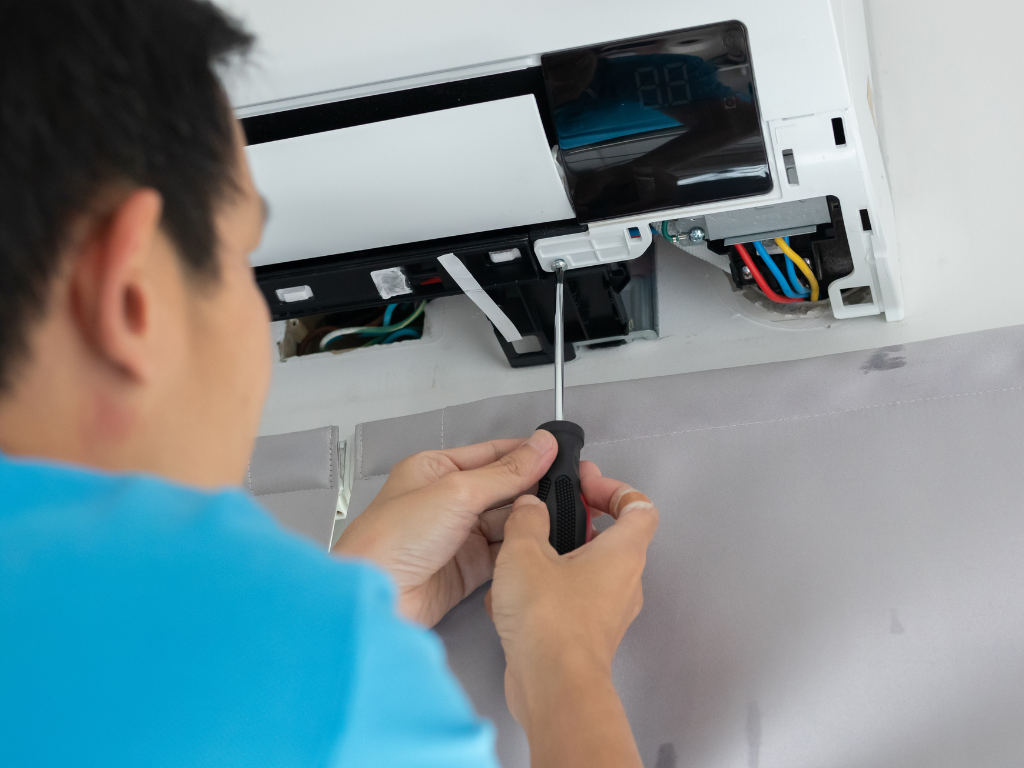
Office BTU sizing: 60 to 80 per square foot, not 50
The residential rule of thumb in Singapore is 50 to 60 BTU per square foot. Offices sit at 60 to 80 BTU per square foot depending on four conditions: occupancy density, computer and server load, glazing percentage, and whether there’s a pantry or printing area. Undersize an office and the unit runs flat out all day, never reaches setpoint, and the compressor dies inside 5 years. Base sizing figures to work from:
| Office size | Standard layout | Higher heat load (dense, sun-facing, pantry) |
| 500 sqft | 30,000 BTU | 38,000 to 40,000 BTU |
| 1,000 sqft | 60,000 BTU | 72,000 to 80,000 BTU |
| 1,500 sqft | 90,000 BTU | 108,000 to 120,000 BTU |
| 2,000 sqft | 120,000 BTU | 144,000 to 160,000 BTU |
Apply these adjustments on top of the base number:
- West-facing or floor-to-ceiling glass: add 15%
- Workstation density above 1 person per 80 sqft: add 10%
- Server room or equipment-heavy zone: treat as separate calculation
- Pantry or hot food prep: add 4,000 BTU for the zone containing it
A 1,000 sqft shophouse office on the second floor facing west, with 10 workstations and a pantry, works out to around 75,000 BTU total. That translates to a Daikin or Mitsubishi multi-split System 4 with mixed indoor capacities, or two ceiling cassettes at 36,000 BTU each. Before signing a quote, ask the installer to produce the calculation in writing. A proper on-site inspection captures ceiling height, glazing, and electrical capacity before BTU is committed.
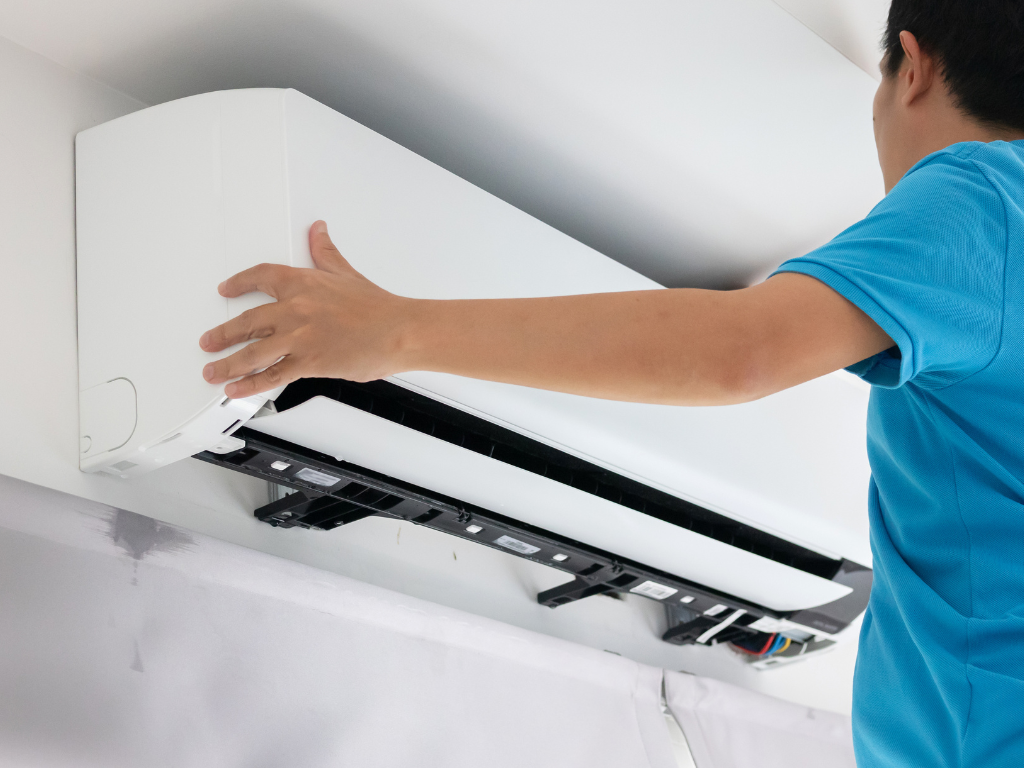
Equipment choice: wall-mount, cassette, multi-split, or VRF
Wall-mounted split works for offices under 350 sqft or for enclosed director’s rooms inside a larger office. Cheapest per unit ($650 to $1,300 installed), visible on the wall, suitable where aesthetics take second place to cost.
Ceiling cassette (4-way) is the default for open-plan offices between 400 and 1,200 sqft. Mounted into a suspended ceiling, it blows air in four directions, delivers even coverage, and disappears visually. A 24,000 BTU cassette covers roughly 350 to 400 sqft of office space. Installation requires a false ceiling with at least 300mm clearance above. Typical installed cost runs $2,200 to $3,400 per unit including the ceiling cut-in and trunking.
Multi-split System 3 or 4 is the right answer for segmented offices with mixed room types (reception, meeting rooms, workstations). One outdoor compressor supplies 3 or 4 indoor units, each sized to its room. Installed cost: System 3 runs $2,500 to $3,800, System 4 runs $3,000 to $4,500 at mid-range brand tier. Configuration flexibility is the main advantage; you can mix wall-mounted indoors for enclosed rooms and cassettes for open areas on the same compressor if the brand and refrigerant capacity match.
VRF or VRV starts making economic sense above 2,000 sqft or when zone count passes six. Daikin VRV and Mitsubishi City Multi both allow independent temperature control per zone using one outdoor unit with much higher combined BTU capacity. Upfront cost jumps sharply (expect $12,000 and up for a small VRF setup), so most offices in the 500 to 2,000 sqft band are better served by multi-split or cassette. Skip brand-mixing across a single outdoor unit. Connection ratio between indoor and outdoor units is brand-specific.
Real cost breakdown for small office installation 2026
Standard Singapore market ranges for commercial aircon installation, inclusive of unit, labour, standard materials, basic electrical work, and NEA-compliant 5-tick equipment for multi-split. A clear scope on commercial aircon installation should itemise each of these rather than quoting a single lump sum:
| Setup type | Typical installed price 2026 | Best fit |
| 2 wall-mounted splits | $2,600 to $4,000 | Small shophouse, up to 600 sqft |
| 2 ceiling cassettes (24,000 BTU each) | $4,400 to $6,800 | Open-plan 700 to 1,000 sqft |
| Multi-split System 4 | $3,500 to $5,500 | 800 to 1,500 sqft mixed layout |
| 3 ceiling cassettes (36,000 BTU each) | $7,200 to $10,500 | Open-plan 1,200 to 1,800 sqft |
| Small VRF (5 to 6 indoor units) | $12,000 to $18,000 | 1,500 to 2,000 sqft with 6+ zones |
Factors that push the number up:
- 3-phase power upgrade. Any total system above roughly 50,000 BTU often requires 3-phase supply. If the unit only has single-phase, add $1,500 to $3,500 for the electrical upgrade.
- Concealed ducting. Running refrigerant and drain lines above false ceilings adds $400 to $800 per unit compared to exposed trunking.
- After-hours or weekend install. Working outside business hours typically carries a 25% to 35% premium, sometimes more for public holidays.
- BCA-licensed bracket work. External brackets for shophouse-level outdoor units require BCA-registered contractor licensing under the Air-Conditioning, Refrigeration & Ventilation Works workhead. Verify the contractor’s registration on the BCA directory for mechanical and electrical contractors before signing.
- Fire safety rectification. Any ducting or piping penetration through a fire-rated wall needs fire-stopping compound, which adds labour.
Multi-split systems must meet the 5-tick minimum efficiency standard effective from 1 April 2025. Full detail on the minimum efficiency rules sits on the NEA MEPS reference page. Non-compliant equipment sold as clearance stock doesn’t carry new-unit warranty.
Downtime planning: install without shutting the office
Install duration at this scale is predictable if the site survey is accurate.
- 2 wall-mounted splits: 1 full working day
- 2 ceiling cassettes with false ceiling prep: 1.5 to 2 days
- Multi-split System 4 with existing trunking: 1.5 days
- Multi-split System 4 with concealed ducting: 2 to 3 days
- Small VRF (5 to 6 indoor units): 3 to 5 days
Three scheduling approaches cover most office scenarios. Weekend install is the default for client-facing offices (Friday evening to Sunday evening). Premium adds roughly 30% to labour but avoids lost billable hours. Phased install works when zones can be isolated: install meeting rooms Thursday night, open-plan area Friday night, pantry zone Saturday. Overnight pressure-test window shortens the last day by holding vacuum and pressure test overnight, then commissioning first thing next morning before the team arrives.
Commissioning deserves more attention than most installers give it. A proper pressure test for System 4 and multi-split setup holds vacuum at 500 microns for at least 15 minutes before charging refrigerant. Cutting the vacuum hold short is where slow refrigerant leaks start, and you pay for it 12 to 18 months later when cooling drops off. For urgent issues during business hours after the install, having a contract for emergency troubleshooting with a defined response window is what keeps downtime costs predictable.
Regulatory and approval checklist
Five items to clear before any aircon installation in Singapore goes ahead at office scale, especially when the unit sits inside a managed building. The full list of aircon installation in Singapore compliance steps for commercial premises looks like this:
MCST approval applies to any office sitting inside a strata-titled commercial building. Approval covers outdoor unit placement, visible piping routes, working hours, and bracket type. Lead time runs 2 to 3 weeks. Don’t let an installer start work without written MCST approval, because fines and remedial costs fall on the tenant.
BCA contractor registration covers external bracket work. Any aircon contractor working on bracket installation for external compressor units should be registered under the Mechanical & Electrical group, workhead ME01 (Air-Conditioning, Refrigeration & Ventilation Works). This protects you if the bracket ever fails.
NEA energy performance standards require all newly sold multi-split systems (System 2 and above) to meet the 5-tick minimum from 1 April 2025. Single-split systems must meet 4-tick minimum.
Electrical load calculation against your existing DB (distribution board) capacity. For any total system above 50,000 BTU, budget for a 3-phase power check. A licensed electrical worker confirms whether the existing supply handles the new load or requires an upgrade via SP Group.
Fire safety clearance applies when ducting crosses fire-rated compartmentation. The installer must use approved fire-stopping material at all penetrations. For larger offices, this may need a Qualified Person signoff.
Post-install service planning for offices
Offices run aircon 10 to 12 hours a day, 5 to 6 days a week. That’s roughly double residential duty cycle, and filters clog faster. The recommended maintenance rhythm for small offices:
- General servicing every 3 months (filter wash, drainage check, refrigerant pressure check)
- Chemical wash every 12 to 18 months per unit
- Full commissioning check annually for multi-split and cassette systems
General aircon servicing on a contract basis beats one-off booking for offices because response time is predictable and scheduled rotations prevent the mid-afternoon breakdown that kills client meetings. A quarterly contract covers general servicing, and the chemical wash cycle gets planned around quieter weeks. For offices still deciding on service approach, the trade-offs between one-off servicing versus a contract become more obvious once annual cooling hours are calculated. A 3-unit small office at 12 hours daily racks up roughly 15,000 cooling hours per year across the system, which is where contract servicing starts saving money on breakdown repairs.
Conclusion
Small office aircon installation in Singapore 2026 lives in a narrow band between domestic rules and commercial VRF economics. The decisions that matter most are written BTU calculation, right equipment for the layout, and installer competence for after-hours work and BCA-regulated bracket fixing. Get those three right and the rest is schedule management.
SACES installs and services aircon for small commercial premises across Singapore, including shophouses, offices, clinics, and F&B spaces. Licensed under bizSAFE STAR, ISO 45001, and SCAL, with weekend and after-hours slots available. Book a quote for your office setup, or book a site survey at Solar Aircon or call +65 6744 6073 for a written breakdown that includes heat load calculation, 5-tick equipment specification, BCA-compliant bracket work, and a downtime plan matched to your office hours.
Frequently Asked Questions
How much does aircon installation cost for a small office in Singapore?
Installed cost for a small office in 2026 runs $2,600 to $10,500 depending on setup. Two wall-mounted splits sit at the lower end, multi-split System 4 covers the middle, and three ceiling cassettes for open-plan offices sit higher. Add 25% to 35% for after-hours work and more if a 3-phase power upgrade is needed.
How long does aircon installation take in an operational office?
A 2-unit ceiling cassette install takes 1.5 to 2 days including false ceiling work. Multi-split System 4 runs 1.5 to 3 days depending on concealed ducting. Most client-facing offices schedule weekend installs (Friday evening to Sunday) to avoid operational disruption, with a premium of roughly 30% on labour.
Ceiling cassette or multi-split for a 1,000 sqft office?
Ceiling cassette wins for open-plan layouts because air distributes evenly from a single point and the unit hides into the false ceiling. Multi-split wins for segmented offices with mixed room types, because each indoor unit sizes independently to its zone. A mixed configuration on one multi-split System 4 is often the best answer.
Do I need BCA approval for office aircon installation?
BCA approval isn’t required for the aircon unit itself, but external bracket installation should be done by a contractor registered under Air-Conditioning, Refrigeration & Ventilation Works (workhead ME01). MCST approval is required for any office inside a strata-titled commercial building, covering piping routes and outdoor placement.
How often should a small office aircon be serviced?
Offices need general servicing every 3 months, not 6, because daily runtime is roughly double residential usage. A chemical wash every 12 to 18 months keeps the evaporator coil clean and holds efficiency close to the 5-tick rating. A quarterly contract prevents the client-meeting breakdown.