
You paid for a gas top-up and the room is still warm. Or worse, there is ice creeping along the copper pipe. Both are common complaints in Singapore, and both usually point back at the job you just paid for. Warm air means the technician put in too little refrigerant, or topped up a system that is still leaking. Ice means they put in too much. Most contractors here warrant refrigerant work for 30 to 60 days, so who pays to fix it often depends on how fast you call and what the invoice says. Here is how to read the symptom, and what to do if the contractor stops picking up. Our SACES aircon services in Singapore cover the diagnostic either way.
Why is my aircon warm after a gas top-up?
Three things cause warm air after a top-up: the technician added too little refrigerant, the leak is still open, or the real fault was never refrigerant in the first place.
Undercharge happens when the technician reads pressure off a gauge instead of weighing the refrigerant in. You end up below factory charge, and cooling capacity drops with it. You will notice weak cooling, not zero cooling, within 24 to 48 hours of the visit. Check it yourself: hold a thermometer at the supply grille, then at the return. A healthy system shows a 10 to 14°C difference. Under 8°C, you are undercharged.
An unresolved leak means the contractor refilled a system that never stopped losing gas. How fast the symptoms come back depends on the leak rate, anywhere from days to a few weeks. This is what happens when leak location gets skipped. Ask the contractor one question: did you locate the leak before topping up? If the answer is that they did not need to, you have your answer.
A non-refrigerant fault was never going to be fixed by adding gas. A dirty evaporator coil chokes airflow. A failed run capacitor stops the compressor from starting properly. A thermostat reading the room wrong will cycle the unit off before it cools. Any of these needs a proper diagnostic, which is what our aircon repair and troubleshooting service is for.
If cooling is still off within 30 days of the top-up, call the original contractor now rather than waiting to see if it settles. Standard warranty terms cover you during that window.
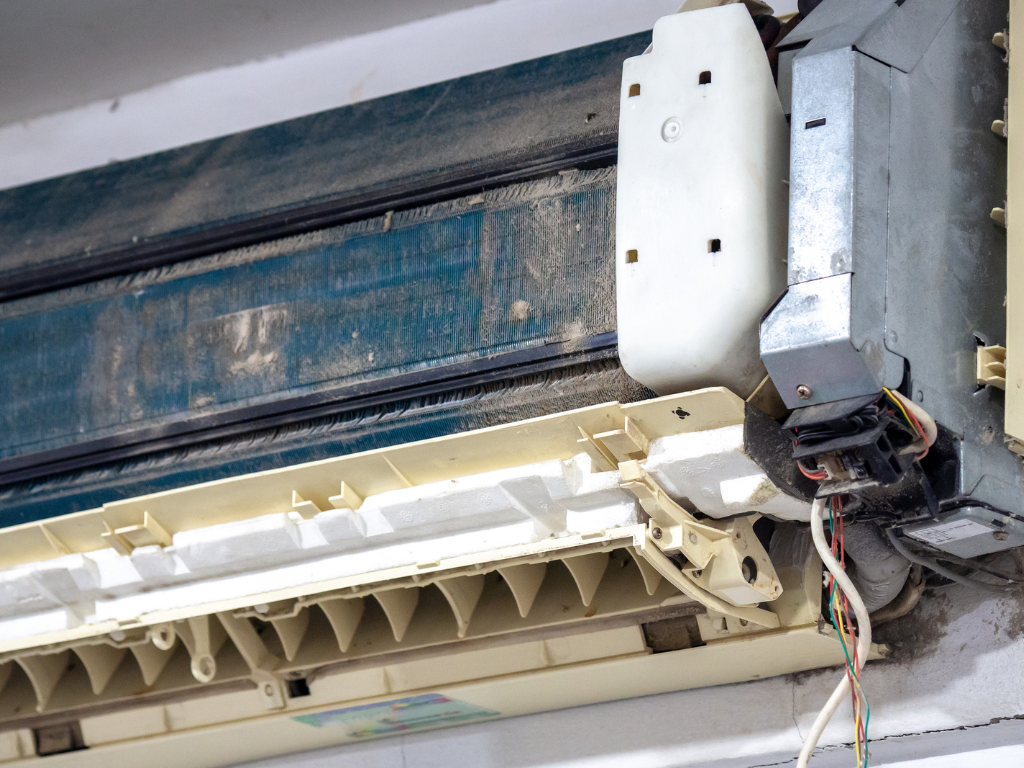
Why is my aircon iced up after a gas top-up?
Ice after a top-up points to overcharge or to airflow the coil is not getting. Overcharge is the technician’s mistake. A dirty coil was already there, and they should have flagged it before charging the system.
With overcharge, the technician put in more refrigerant than the factory specification calls for. High-side pressure climbs, the suction line drops below dew point, and moisture in the room air freezes onto the copper. You will see frost on the suction line, the larger of the two copper pipes running to the outdoor unit, and sometimes on the evaporator fins. Cooling often starts strong, then fades as the ice blocks airflow.
With a dirty coil, biofilm and dust coat the evaporator and kill heat transfer, so the coil surface runs colder than designed. Ice forms on the coil and the pipe beside it. The top-up did not cause this, but a technician who opened the unit should have seen it.
Wrong refrigerant is rare and it does happen. R22 going into an R32 system, or the reverse. Pressures behave strangely and the icing pattern makes no sense. Fixing it means full recovery and a recharge with the correct gas.
If the ice is on the suction line, the aircon pressure test service settles the question: pressure above normal means overcharge, pressure normal means your airflow is the problem.
Overcharge is contractor error. Within warranty, they correct it at their cost.

What does ice on the suction line mean?
Ice on the suction line means refrigerant is evaporating below the dew point of the air around the pipe, so water vapour condenses on the copper and freezes. Overcharge, restricted airflow across the evaporator, or a stuck expansion valve will each do it.
In normal operation the suction line sits 5 to 10°C above ambient dew point. Singapore dew point usually runs 20 to 24°C, which keeps the line above 15°C. For ice to form, that line has to fall below 0°C, and nothing about a healthy system takes it there.
Overcharge pushes liquid refrigerant further down the line than it should reach, so evaporation happens along the suction line itself and the surface temperature falls. Restricted airflow, whether from a clogged filter or a filthy coil, starves the evaporator of the warm room air it needs to absorb heat from, so again the refrigerant carries on evaporating past where it should. A stuck expansion valve meters refrigerant incorrectly and throws pressure off downstream.
Do not leave it running. Half an hour of continuous operation with an iced suction line already stresses the compressor. Liquid refrigerant reaching a compressor built for gas damages the motor windings, and running the unit for hours in that state is how a $200 dispute turns into a compressor replacement. Switch it off and call the contractor.
Is there a warranty on aircon gas top-up work?
Yes. Most established Singapore contractors warrant refrigerant top-up work for 30 to 60 days, and some go to 90. The warranty covers the charge and the diagnostic behind it. It does not cover repairing the leak, unless the leak repair was part of the same job.
What a standard top-up warranty should cover:
- Refrigerant weighed to factory specification, within about 5% tolerance
- The correct refrigerant type for your system
- No pressure or icing problems created by the top-up itself
- A return visit at no charge once contractor error is confirmed
What it will not cover:
- Refrigerant still escaping from a leak nobody repaired
- Compressor or component failure that has nothing to do with the charge
- Damage you caused, including a blocked filter or tampering with the unit
- Voltage surge or water intrusion
Skip any contractor who will not put warranty terms in writing for refrigerant work. Those written terms are the only thing you can hold them to if the job goes wrong. Confirm them before you authorise anything. Book the aircon gas top-up service and you get the terms up front, in writing.
Who pays if the top-up didn’t work?
It comes down to what failed and whether you are still inside the warranty window. Technician errors are the contractor’s cost. Faults that have nothing to do with the refrigerant charge are yours. Leaks sit in between, and the deciding factor is what the contractor told you at the time.
The contractor pays when:
- Undercharge. They come back, verify the charge weight, and add whatever refrigerant it takes to reach factory specification, at their expense.
- Overcharge. They recover the excess, recharge correctly, and verify the system runs properly. If the unit ran overcharged long enough to hurt the compressor before anyone diagnosed it, expect a negotiation. Those costs usually get split.
- Wrong refrigerant. Full recovery, system flush, and a recharge with the right gas. That is a $180 to $450 job and the contractor wears it.
You pay when:
- The leak sits outside what you paid for. You cover the leak repair, though the contractor may still cover the second top-up if you are inside warranty.
- The fault turns out to be a capacitor, a coil, or a thermostat. The top-up did not cause it, so it is not their bill.
- The warranty window has closed. Past 30 to 60 days, the cause stops mattering.
The grey area is the leak nobody repaired. If the contractor told you the system was leaking and you authorised a top-up anyway, the second top-up is on you. If they never mentioned it, the second top-up is on them, and repairing the leak is a separate job you will still need to pay for.
All of which turns on paperwork. An invoice naming the refrigerant type, the weight added, and the diagnostic notes protects you and the contractor equally.
What are my callback rights?
Inside the warranty window, you can ask for a return visit at no charge once contractor error is confirmed. Contractors worth using answer callbacks within 24 to 72 hours.
Call the original contractor while you are still inside the window. Describe the symptom plainly, whether that is weak cooling, ice on the suction line, or cooling that keeps fading, and ask for a diagnostic and correction.
They should book you in within 24 to 72 hours. Longer than that with no explanation, or a flat refusal, and you have grounds for a formal complaint.
At the visit, the technician should measure current pressure against specification, weigh out any refrigerant they recover, name the specific cause, and correct it. Ask for a written summary of what went wrong and what they did about it. Neither side benefits from a verbal account nobody can produce later.
If it takes more than one visit to fix the same fault, those visits are on the contractor. A contractor who needs three attempts at one problem is telling you something about their diagnostic skills, and you can act on that when the next service comes round.
When the original contractor goes quiet or argues the callback, bring in a second contractor for a diagnostic. Their written report is what you will use if this goes formal.
Should I get a second opinion before the callback?
Get one if the original contractor has gone unresponsive, if the first diagnosis looked wrong to you, or if the symptoms point somewhere the top-up was never going to reach. An independent diagnostic puts the current state of your system in writing, which is what makes a callback request or a dispute stick.
Four situations justify the spend:
The contractor has not replied in 48 hours. Get the system documented now, while the evidence is fresh and the symptoms are still what you described.
You suspect the original diagnosis was wrong. Someone told you a top-up would fix it, but the pattern looks more like a leak, a compressor fault, or something outside the refrigerant circuit entirely.
You are getting contradicted. The contractor says the warranty does not cover what is happening, and you think it should. An independent read settles who is right.
You are preparing a complaint. Going to CASE or the Small Claims Tribunal without a diagnostic report from a second contractor leaves you arguing your word against theirs.
An independent diagnostic costs $80 to $150 in Singapore in 2026. Our inspection service covers the full system and gives you the written report.
Time it based on the contractor. If you doubt their competence, get the second opinion first. If the callback happened and the fix did not hold, get it after.
Can I escalate to a formal dispute?
Yes. If the contractor refuses the callback, or comes out and fails to fix it, you have two routes: mediation through CASE Singapore, or a formal claim at the Small Claims Tribunal.
CASE Singapore takes your complaint by hotline or online form and mediates between you and the business. Mediation costs nothing to file. How well it works depends on whether the contractor engages. The Consumers Association of Singapore (CASE) handles consumer complaints against Singapore businesses, aircon service disputes included.
The Small Claims Tribunal is the formal route, through the State Courts. Consumer service disputes fall squarely within its jurisdiction. The claim limit is $20,000, or $30,000 if both sides sign a Memorandum of Consent. You have 2 years from the date of the disputed service to file. Filing costs $10 to $60 depending on claim value, and you get a consultation date within 10 working days. No lawyers: you argue your own case and so does the contractor. The Singapore State Courts Small Claims Tribunals usually close a case within 3 months of filing, and aircon disputes in the $80 to $500 range are routine there.
Most post-top-up disputes never get that far. CASE mediation resolves the bulk of them, and the tribunal is there for contractors who will not come to the table.
What to do in the first 48 hours
Warm air or ice after a gas top-up almost always traces back to the service itself, whether that is undercharge, overcharge, or a leak nobody repaired. It is rarely a coincidence. Refrigerant work carries a 30 to 60 day warranty as standard, and inside that window a verified error is the contractor’s to fix at no cost to you. If they will not engage, CASE mediation costs nothing and the Small Claims Tribunal handles claims to $20,000 for a $10 to $60 filing fee.
Book a diagnostic with SACES if you want an independent read on what went wrong. You get a written report you can use for the callback request, or attach to a formal complaint if the original contractor’s work needs documenting.
FAQs About Aircon Warm After Gas Top Up
How long should I wait before calling the contractor back?
Call within 24 to 48 hours of noticing the problem. Symptoms appearing inside 7 days of the service are your strongest evidence of contractor error. Once you pass the warranty window, usually 30 to 60 days, you are the one who has to prove what happened. Write down the exact symptoms and photograph any ice or condensation while it is there.
Can overcharge damage my aircon compressor?
Yes. An overcharged system sends liquid refrigerant into a compressor designed to handle gas only, which is called slugging, and it wrecks the motor windings and valves. Damage tends to show after 10 to 30 hours of running overcharged. If you see ice on the suction line, switch the unit off and call the contractor rather than waiting for the weekend.
What documentation should I keep from the top-up service?
Keep the original invoice with the refrigerant type and weight added, the diagnostic notes, the contractor’s business name and contact, the service date, and the warranty terms in writing. Photograph the nameplate on your outdoor unit too, since it carries the factory charge weight. That set of documents is what a callback request or a formal complaint runs on.
Can I ask for a refund if the top-up failed?
For contractor error, yes. Once a callback or second-opinion diagnostic confirms undercharge or overcharge, ask for free correction or a partial refund covering the refrigerant you cannot use. A full refund on the whole service rarely happens. The normal remedy is correction plus money back on the wasted gas. Take it to CASE if the contractor refuses.
Can I sue the aircon contractor for damage caused by overcharge?
You can bring a claim at the Small Claims Tribunal for damage under $20,000. Compressor damage from running overcharged is recoverable if your documentation shows both the overcharge and the damage that followed. Filing runs $10 to $60 and you have 2 years from the service date. A diagnostic report from a second contractor does more for the claim than anything else you can bring.