
Aircon gas top up cost Singapore in 2026 runs $80 to $280 per residential unit. Where you land in that range comes down to what refrigerant your system uses, how big it is, and whether the contractor bundles leak location or a pressure test into the price. R32 is cheapest at $80 to $150. R410A sits at $120 to $200. R22 hits $150 to $280 because supply keeps shrinking. Below is what each line on the quote should cost you, and which quotes to walk away from. Pricing here reflects the aircon gas top-up service rates you can expect in Singapore this year.
How much does aircon gas top-up cost in Singapore in 2026?
Aircon gas top-up costs $80 to $280 per residential unit in Singapore in 2026. Three things move the number: refrigerant type (R22 costs 2 to 3 times more per kg than R32), system size, and what the contractor folds into the quote.
On a single-split system, expect:
- R32 top-up: $80 to $150, the industry default and the cheapest
- R410A top-up: $120 to $200
- R22 top-up: $150 to $280, carrying the phase-out premium
Run a System 3 or System 4 and you pay 20% to 40% more, because those systems hold a heavier refrigerant charge.
Base price normally buys you the service call, enough refrigerant to reach correct charge, and a quick gauge check at the service port. The add-ons are where quotes separate: a full pressure test with 24-hour hold runs $30 to $60, leak location $50 to $100, certified R22 recovery $30 to $60, and disposal of the old refrigerant $10 to $30.
Stack all of that on a leaking R22 System 3 and you are looking at $350 to $450. At that number, replacing the unit usually costs you less over the next three years than keeping it alive.
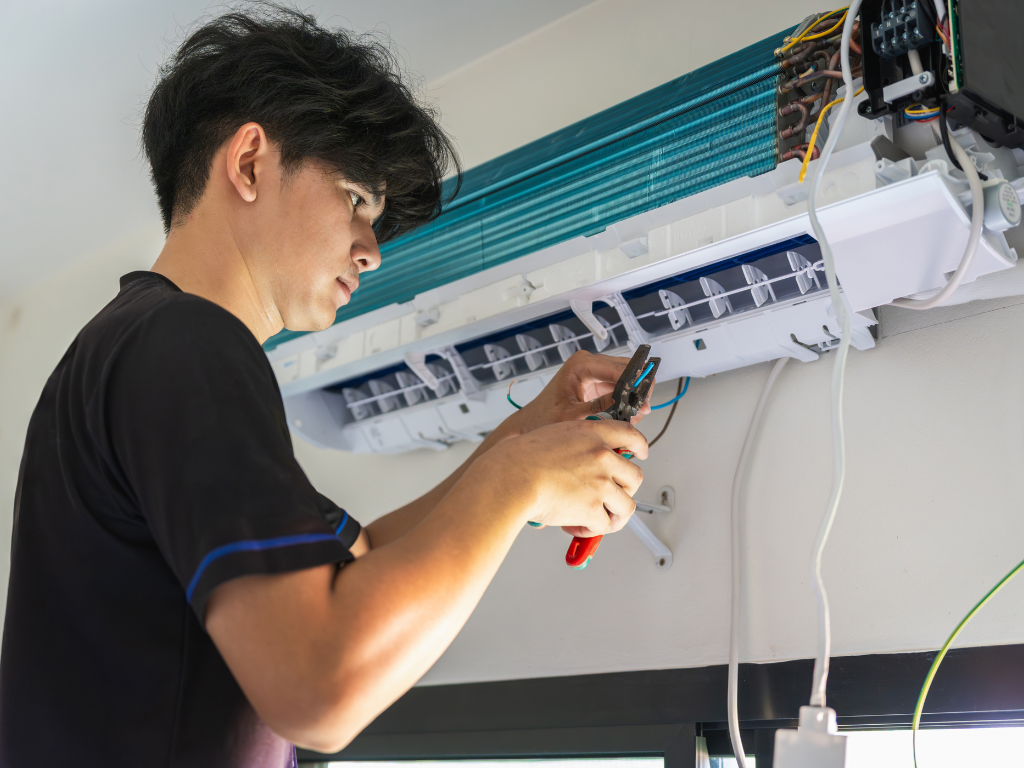
What’s the R22 refrigerant top-up cost in Singapore?
R22 refrigerant top-up in Singapore in 2026 costs $150 to $280 per residential unit. The refrigerant alone runs $70 to $140 per kilogram, two to three times the per-kg price of R32, and the Montreal Protocol phase-out is the reason.
A typical R22 job breaks down like this. Service call and technician time comes to $40 to $80. The refrigerant itself, 0.4 to 0.7 kg on a single split, adds $40 to $100. NEA rules require a certified handler to recover any old refrigerant rather than vent it, which puts another $30 to $60 on the bill. A basic pressure check is included.
Most straightforward R22 top-ups land at $150 to $250. A full pressure test with hold pushes it up $30 to $80. Leak location adds $50 to $100 on top of that.
Supply is the problem. Global R22 production stopped in 2020, and Singapore has been running down stockpile through servicing on legacy units ever since. Prices have climbed 15% to 25% a year since 2022 and show no sign of levelling off. The UNEP Ozone Secretariat sustainable cooling policy toolkit sets out the phase-down framework behind the squeeze.
Do the maths if you still run R22. Two top-ups a year at $200 each is $400 annually, or $2,000 across five years. Swapping to an R32 unit costs $700 to $1,400 and pays for itself inside three to four years. Our aircon installation and replacement team handles that transition, including sizing and disposal of the old system.
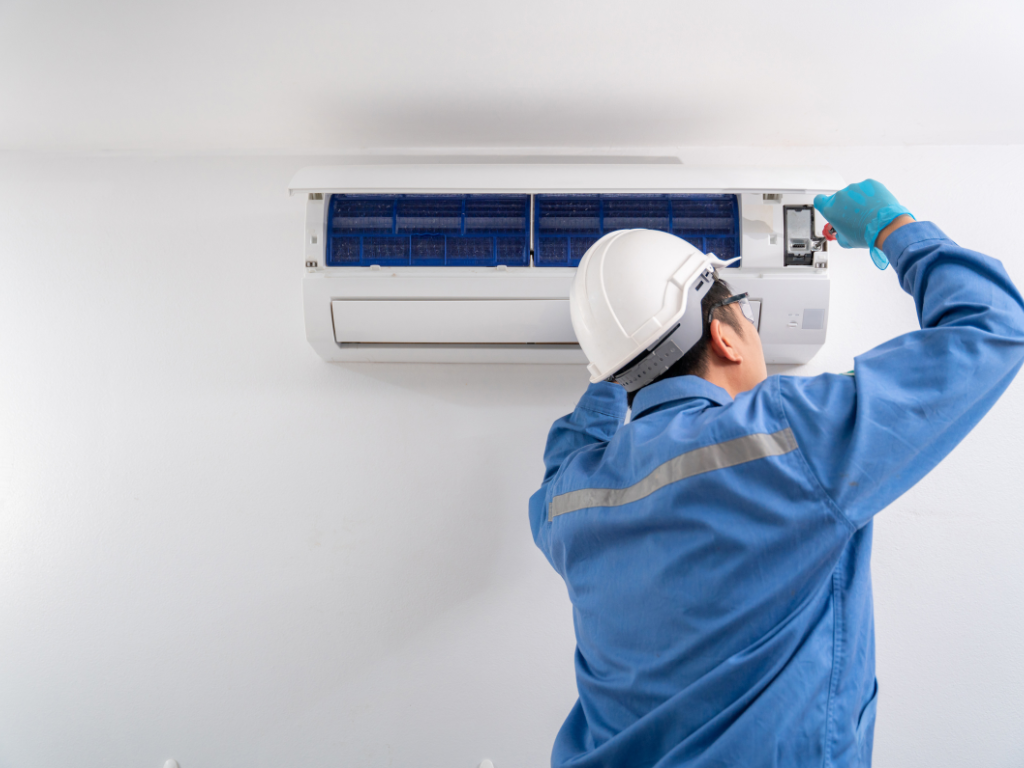
What’s the R410A gas top-up cost?
R410A gas top-up in Singapore costs $120 to $200 per residential unit in 2026. The refrigerant runs $50 to $90 per kilogram, so it sits between scarce R22 and abundant R32.
On a standard job you pay $40 to $80 for the service call and technician time, $40 to $75 for 0.5 to 0.9 kg of refrigerant on a single split, and $20 to $40 to recover residual gas, which any decent contractor will recommend. Basic pressure check comes with it. Most jobs total $120 to $180. A full pressure test adds $30 to $60; leak location adds $50 to $100.
Manufacture is tightening elsewhere. The US banned R410A in new residential HVAC manufacture from January 2025 under the AIM Act. Singapore servicing supply continues for now, though availability will tighten through 2028 to 2030 and prices will follow.
Most R410A units in Singapore homes went in between 2010 and 2020, so they are 5 to 15 years old. If yours is under 8 to 10 years old and only losing gas slowly, topping up makes sense for a few more years. Past that, weigh the annual spend against replacement. Our aircon repair and troubleshooting technicians will tell you which side of that line your unit falls on.
What does R32 gas top-up cost?
R32 gas top-up in Singapore costs $80 to $150 per residential unit in 2026. At $30 to $60 per kilogram, R32 is the cheapest of the three common residential refrigerants, largely because every new system installed since 2020 uses it.
The service call and technician time still runs $40 to $80. Refrigerant is the cheap part: 0.4 to 0.7 kg on a single split costs $15 to $40. Recovery of residual gas adds $10 to $30, and the basic pressure check is included. Most jobs come to $80 to $130. Add $30 to $60 if you want the full nitrogen pressure test at 300 to 500 psi with a 24-hour hold, or $50 to $100 for leak location.
R32 supply is steady, per-kg pricing is stable, and manufacturers will keep parts available for another 15 to 20 years. Of the three refrigerants, R32 carries the lowest risk of a surprise on the final invoice.
Bigger systems still cost more. A System 3 on R32 runs $120 to $200 and a System 4 runs $150 to $250, both because of the heavier charge weight. Ceiling cassettes add 10% to 20% since the technician is working overhead.
If your R32 unit is under 8 years old and losing gas from one spot, a single top-up buys you time while you arrange a proper repair. Book the aircon pressure test service first so the leak is confirmed before anyone charges the system.
Why is R22 top-up more expensive than R32?
R22 top-up costs 2 to 3 times more than R32 because the supply is disappearing. Production ended globally in 2020 under the Montreal Protocol, and what remains in Singapore gets consumed servicing old units. Less supply each year, higher price each year.
The premium comes from three places. Material cost is the biggest: R22 sells at $70 to $140 per kg against $30 to $60 for R32. Handling is the second. NEA rules require certified handlers to recover old R22 rather than vent it, which adds $30 to $60 of labour to every job. The third is the contractor’s own risk pricing. R22 systems are typically 12 years old or more, diagnosis takes longer, and handlers who work on them charge accordingly.
Since 2022, R22 prices in Singapore have risen 15% to 25% a year, tracking the global phase-down schedule. Expect that to continue through 2027 to 2030. By 2028, the same job that costs you $150 to $280 today will likely run $200 to $350.
That is the trap R22 owners are in. Every year you delay replacement, the cost of keeping the old unit running goes up while the cost of a new R32 system stays flat.
What determines the price of aircon gas top-up?
Six things set the final number: refrigerant type, charge weight, leak location, pressure test inclusion, contractor licensing, and how fast you need someone on site.
Refrigerant type is the single biggest driver, as the sections above show. R22 costs 2 to 3 times R32 per kg, with R410A in between.
Charge weight scales with system size. A single split at 9,000 to 12,000 BTU holds 0.4 to 0.7 kg. System 2 holds 0.8 to 1.2 kg, System 3 holds 1.2 to 1.8 kg, and System 4 holds 1.5 to 2.5 kg. Ceiling cassettes hold more than wall-mounted units at the same BTU rating.
Leak location matters more than most homeowners realise. Losing more than 10% of your refrigerant in a year means you have a leak. Finding it with a nitrogen pressure test plus soap solution or an electronic detector adds $50 to $100. Skip it and you will pay for the same top-up again in a few months.
Pressure test inclusion varies by contractor. The 5 to 10 minute gauge check is standard in most quotes. The full test at 300 to 500 psi with a 24-hour hold is a $30 to $60 add-on.
Contractor licensing costs $10 to $30 more per job for an NEA-certified handler. That certification is legally required for R22 work and standard practice for R32 and R410A.
Urgency carries a 20% to 30% premium if you want someone out the same day instead of booking for tomorrow.
How much refrigerant does a Singapore aircon need?
Charge weight depends on system type and cooling capacity. For single-split units:
- 9,000 BTU: 0.4 to 0.5 kg
- 12,000 BTU: 0.5 to 0.7 kg
- 18,000 BTU: 0.7 to 0.9 kg
- 24,000 BTU: 0.9 to 1.2 kg
For multi-split systems, total charge across the whole system:
- System 2 (1 outdoor, 2 indoor): 0.8 to 1.2 kg
- System 3 (1 outdoor, 3 indoor): 1.2 to 1.8 kg
- System 4 (1 outdoor, 4 indoor): 1.5 to 2.5 kg
- System 5 (1 outdoor, 5 indoor): 2.0 to 3.0 kg
Check the nameplate on your outdoor condenser. It lists the factory charge weight in grams or ounces, and that figure is the reference point for any recharge. A top-up usually replaces 10% to 40% of it, depending on how much escaped.
On a slow leak, the technician reads current pressure, works out the deficit against factory charge, and adds that weight. Getting it wrong hurts either way: too much refrigerant strains the compressor, too little leaves you with weak cooling.
Digital charging scales accurate to within 10 grams are standard equipment. If your contractor is eyeballing the amount instead of weighing it, that is corner-cutting. Ask to see the scale reading before you pay.
What’s the difference between top-up and full recharge?
A top-up adds refrigerant until the system reaches correct charge. A full recharge empties the system, dries it under vacuum, and refills it with new refrigerant. Top-ups cost $80 to $280. Full recharges cost $180 to $450.
The top-up takes 30 to 60 minutes. Technician measures current pressure, calculates the deficit, adds refrigerant through the service port until pressure matches spec. That is enough for a slow leak or a system under mild stress.
A full recharge takes 2 to 4 hours. The technician recovers the existing refrigerant, which NEA rules require for R22 and good practice calls for on R410A and R32, pulls the system down to 500 microns Hg of vacuum, runs a nitrogen pressure test at 300 to 500 psi with a 24-hour hold, then weighs in fresh refrigerant to factory specification.
You pay two to three times more for the recharge because of the extra hours and the nitrogen, and what you get back is proof the system actually holds pressure.
Go with the full recharge after a leak repair, after a compressor replacement, if the unit has needed several top-ups in the past 12 months, or if you are selling the flat and want documented system integrity for the buyer’s inspection.
If nothing is leaking, you need neither. Refrigerant does not wear out inside a sealed system. Any contractor who tells you it needs topping up as routine maintenance is selling you gas you do not need.
What should a fair gas top-up quote include?
A fair quote itemises seven things and totals within market range for your refrigerant. If the contractor will not itemise, that tells you something.
- Service call fee, $40 to $80, stated on its own line rather than buried inside “labour”
- Refrigerant type, named as R22, R410A or R32
- Estimated charge amount in kg or grams
- Per-kg refrigerant price, so you can check it against 2026 market rates
- Recovery of existing refrigerant, $30 to $60 where it applies
- Basic pressure check, usually included and stated as such
- Optional extras priced separately: full pressure test $30 to $60, leak location $50 to $100, disposal $10 to $30
Walk away from these:
- Anything under $50 for a residential top-up. Something got skipped, most likely the pressure check or the recovery.
- Anything over $300 for a straightforward R32 top-up. Either the extras are padded, the per-kg rate is inflated, or the contractor has misread the fault.
- No refrigerant type on the quote. If the contractor has not identified what is in your system, they have not looked at it properly.
- A single line reading “gas top-up service”. You will have no ground to stand on when the final invoice arrives higher.
The Consumers Association of Singapore (CASE) has logged complaints against home service providers over hidden charges and vague quotations. A written, itemised quote is your protection.
Before you authorise the work, ask four questions:
- What refrigerant type is my system running?
- How much refrigerant weight are you adding?
- Is the pressure check included or charged separately?
- If there is a leak, how will you find it?
A competent contractor answers all four without hesitating. Anyone who deflects or asks you to just trust them is planning to cut corners.
What to expect when you book a top-up
Aircon gas top-up in Singapore in 2026 costs $80 to $280 for a straightforward job. Refrigerant type drives the number more than anything else: R32 at $80 to $150, R410A at $120 to $200, R22 at $150 to $280 because supply keeps tightening. Bigger systems, leak location, a full pressure test, and mandatory R22 recovery all push the total up from there. Getting the quote broken into its seven parts is what keeps the final invoice honest.
Book an aircon gas top-up with SACES and you get the quote itemised: refrigerant type, weight, pressure check, and any leak diagnostic, priced before we start. Our inspection service can also confirm whether a top-up is the right fix in the first place, so you are not paying for refrigerant that will leak out again by next quarter.
FAQs About Aircon Gas Top Up Cost Singapore
Is pressure check included in gas top-up price?
The basic check, 5 to 10 minutes with a gauge manifold at the service port, is included in standard top-up pricing. The full nitrogen pressure test at 300 to 500 psi with a 24-hour hold costs an extra $30 to $60. If a contractor bills you separately for the basic check, they are padding the quote. Ask which type of pressure verification you are getting before you agree to the work.
How much do contractors charge per kg of refrigerant?
In Singapore in 2026, R22 runs $70 to $140 per kilogram, R410A $50 to $90, and R32 $30 to $60. Mark-up varies between contractors, but it should be visible on the quote. Above $150/kg for R22 or $80/kg for R32, you are overpaying. Ask for the per-kg rate as part of the itemisation.
Should I get a top-up or replace my old R22 aircon?
Replace it if the unit is 10 years or older, if it needs topping up more than once a year, or if you are hearing compressor noise and getting weak cooling even after a top-up. R22 top-ups at $150 to $280 a year add up to $1,000 to $1,400 over five years, which is what a single-split R32 replacement costs you once at $700 to $1,400.
How long does aircon gas top-up take?
Budget 30 to 60 minutes for a single split, 45 to 75 minutes for a System 2 or 3, and 60 to 90 minutes for a System 4. A full recharge with recovery, vacuum, pressure test and refill takes 2 to 4 hours. Access matters too: ceiling cassettes and tight service balconies add time, as does tracing a leak.
Can I do aircon gas top-up myself to save cost?
No. Singapore restricts refrigerant handling to NEA-certified handlers under refrigerant management rules, and suppliers will not sell refrigerant to anyone without that certification. You would also need a gauge manifold, a digital charging scale and a recovery pump. DIY charging voids your manufacturer warranty and the wrong charge weight damages the compressor, which costs far more than the top-up you were trying to avoid.