
Aircon installer Singapore searches turn up hundreds of results, all claiming to be licensed and certified. Knowing what a properly executed aircon installation looks like is the basis for spotting red flags. This blog will walk you through the credentials that matter and the warning signs across the install timeline.
Why “licensed” claims need verifying
Walk through any HDB block in Singapore and you’ll see the same flyers: “Licensed Aircon Installer”, “Certified Technicians”, “BCA Approved”. The word licensed has become marketing wallpaper. The schemes those words actually point to are specific, narrow, and not interchangeable. A homeowner who can’t tell the difference between a BCA-trained aircon installer and an EMA-licensed electrical worker is paying for one and assuming they got the other. A homeowner who hears “NEA certified” and pictures a single licence is missing that NEA’s residential refrigerant scheme has multiple stages, and not every technician completes all of them. The vetting question isn’t whether the installer is licensed. It’s which licences they hold, who issued them, and whether they’re current.
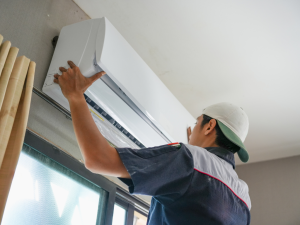
The credentials that actually exist for aircon installers in Singapore
Six credentials apply to residential aircon installation. A genuinely licensed aircon installer holds the relevant ones below, each issued by a specific authority and verifiable through a specific channel.
1. BCA-trained aircon installer
Required under BCA’s air-conditioning safety guidelines for any installation on the exterior of a building. Training is delivered through BCA Academy. The installer carries an identification pass and is registered with BCA. After installation, the installer must submit Form AC-01 (private property) or Form AC-02 (HDB) within 14 days. If your installer can’t tell you which form they’ll submit, that’s a verification failure on its own.
2. NEA R32 installer training stack
Most residential aircons in Singapore today use R32 refrigerant. Handling R32 requires the technician to complete a sequence: the R32 Safety Awareness Training, then a Certificate of Competency in Installation and Commissioning Air-conditioning Systems for R32 split units, and the Certificate of Competency in Residential Air-Conditioning System (Refrigerant) for leak testing, evacuation, and charging. Once a technician completes the residential CoC, their name and company are added to NEA’s publicly published List of R32 Installers under Singapore’s regulated refrigerants framework. This is the practical check most homeowners don’t know about.
3. EMA Licensed Electrical Worker (LEW)
Required for fixed electrical work, including new aircon circuits, isolator switches, and any modification to the distribution panel. The LEW is registered with the Energy Market Authority, not BCA. Easy to confuse, but the issuing authority is different. For most aircon installations, an LEW must be on the team or supervising remotely.
4. ACRA UEN registration
Every legitimate contractor in Singapore has a Unique Entity Number registered with ACRA. The UEN, business address, and registered owner are verifiable on ACRA’s BizFile portal. Cash-only outfits with no UEN aren’t worth the warranty risk on a job that touches fixed wiring or refrigerant.
5. Brand authorisation
Daikin, Mitsubishi, Panasonic, Midea, and York maintain authorised dealer networks. If your unit is going to be under warranty, brand-authorised installation is what keeps the warranty alive. Authorised dealer status appears on the manufacturer’s official website, not just on the contractor’s marketing.
6. Public liability insurance
Reputable residential installers carry S$1 million to S$2 million in cover. This protects you if a unit drops during installation, water damage occurs from a botched drainage line, or a technician is injured on your property. Ask for the certificate of insurance, not a verbal claim. For installations involving refrigerant top-up beyond pre-charged piping length, the aircon gas top-up procedure covers what a certified technician should be doing.
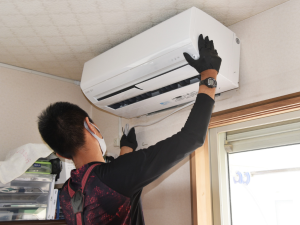
Red flags before install day
Six warning signs that should change your mind before you sign anything.
Quote with no breakdown
A flat lump-sum quote (“$2,400 for full System 3”) with no itemisation usually hides cost-cutting on materials. A real quote breaks down indoor units, outdoor unit, copper piping, drainage, electrical work, brackets, and labour separately, with material grades specified. If the quote can’t be itemised, the work probably can’t be specified either.
No site visit offered
A site visit is where the BTU sizing, electrical capacity, and trunking route get confirmed. Installers who skip this step and quote off room dimensions over WhatsApp are guessing. The result is a one-size-fits-most install that often doesn’t fit yours.
Generic “all our technicians are licensed” claim
Specific is verifiable, generic isn’t. Ask which technician will be on your job, what their NEA R32 certification reference is, and whether they appear on NEA’s List of R32 Installers. A real contractor answers in 30 seconds. A vague contractor pivots.
Pressure to commit before you’ve signed
“Confirm today and we’ll throw in a free chemical wash” is a sales tactic that pushes you past the verification step. The discount evaporates after install day. The install lasts 8 to 10 years.
Verbal warranty terms
Manufacturer warranty (parts coverage, typically 1 year on parts and longer on the compressor) is separate from installation warranty (workmanship, typically 1 year). Both should be in writing. “We’ll come back if there’s a problem” is not a warranty.
Suspiciously low price
A System 3 install priced at less than S$1,800 to S$2,200 (depending on brand and piping length) is usually corner-cutting territory. The general aircon servicing pricing context gives the related servicing benchmarks. If the install quote is significantly below market, something is being skipped, the warranty’s likely void, or both. For replacement scenarios where an existing system is being swapped out, the aircon replacement decision context covers the additional vetting points specific to replacements.
Red flags on install day
Five warning signs that the install is being rushed or shortcut.
Different technician than the one you vetted
You confirmed credentials for a specific named technician at the quotation stage. On install day a different team shows up, no introduction, no credential reference. This happens often when contractors subcontract last-minute. If you can’t verify the on-site technician’s R32 CoC reference, the install hasn’t met the basic standard you booked.
No or fake vacuum test
Before refrigerant goes in, the pipe network must be evacuated to 500 microns or below for at least 15 to 30 minutes. The vacuum pump should be visibly running for that full duration. The vacuum and pressure test process describes what a real evacuation looks like. A 2 to 3 minute pump run followed by opening the gas valve is the most common shortcut and the hardest to spot once the install is finished.
Reused old copper piping without explanation
On replacements, budget installers reuse the existing copper to save material cost. Old copper has internal residue from the previous refrigerant, possible micro-cracks, and uncertain insulation integrity. Reuse can be acceptable if the contractor performs a pressure test. Skipping verification and reusing it anyway is a red flag.
No commissioning report at handover
After gas charging, the unit runs for 15 to 30 minutes for commissioning. Gas pressure, current draw, voltage, fan rotation, drainage flow, and cooling output get measured and recorded. A handover with no commissioning report means none of these were verified. You’re accepting an unverified system.
Hurried completion without explanation
Installs that finish in half the expected time usually skipped a step. Either the vacuum test, the drainage gradient, the bracket inspection, or the commissioning. A 4-hour System 3 install isn’t faster work, it’s incomplete work.
Red flags after install day
Four warning signs that emerge in the days and weeks after the technicians leave.
No Form AC submission within 14 days
BCA-trained installers are required to submit Form AC-01 or Form AC-02 within 14 days of completion. Ask for the submission reference. If the installer doesn’t follow up, the install isn’t documented in the system, your warranty trail is incomplete, and any future dispute has weaker grounding.
Warranty registration left undone
Most manufacturer warranties require the installer or homeowner to register the unit serial number within a specific window (often 30 days). Reputable installers handle this for you and confirm. If three weeks pass and you’ve heard nothing, register it yourself before the deadline lapses.
Cooling performance issues attributed to “settling in”
A new aircon should reach the set temperature within 5 to 10 minutes from start. If the unit takes 20 minutes or doesn’t cool the room properly, that’s not “settling in”. The aircon not cold troubleshooting steps cover the diagnostic flow. Most performance issues at the start trace back to install errors: incorrect refrigerant charge, undersized BTU, poor airflow placement, or commissioning shortcuts that hid the problem.
Difficult to reach for follow-up
The contractor who chased you for the deposit has gone silent on the warranty issue. This is what choosing on price gets you. A reputable contractor wants to maintain the relationship for the scheduled aircon servicing that follows the install. A discount installer doesn’t.
The minimum vetting checklist before signing
Eight items to confirm before you commit to any aircon installer in Singapore.
- UEN registered with ACRA, verified on BizFile
- BCA-trained aircon installer status, with registration reference
- NEA R32 installer status, technician’s name on NEA’s published list
- EMA Licensed Electrical Worker on the team for new circuit work
- Brand authorisation for the unit you’re buying, verified on the manufacturer’s site
- Public liability insurance certificate, S$1M minimum
- Written quote with itemised scope, materials specified, and timeline
- Written warranty terms covering both installation workmanship and parts
If any one of these gets pushback or evasion, that’s the answer. A real contractor has all eight on file and provides them within a working day. Once a contractor clears the list, you can hire a vetted installer with confidence instead of guessing.
Conclusion
The word “licensed” hides more than it reveals. Real verification means checking specific schemes (BCA-trained installer, NEA R32 installer, EMA LEW, ACRA UEN) against specific registries, then watching install day for the shortcuts that aren’t visible in marketing. Most installation problems are decided before drilling starts, in the quote and the credentials. The few that aren’t show up on install day, in the vacuum test and the commissioning report.
If you’re shortlisting installers for a new install or replacement, run the eight-point checklist before you sign anything. When you’re ready to book SACES installation, SACES handles HDB, condo, and small commercial aircon installation across Singapore with BCA-trained technicians, NEA-listed R32 installers, EMA-licensed electrical work, and full documentation including Form AC submission. Speak to the SACES team about your aircon installation.
FAQ About Aircon Installer Singapore
How do I verify an aircon installer is licensed in Singapore?
Check the technician’s name on NEA’s published List of R32 Installers, the contractor’s UEN on ACRA’s BizFile portal, the BCA-trained installer registration with BCA, and the EMA Licensed Electrical Worker on EMA’s licensee portal. Four checks, takes about 15 minutes online.
What’s the difference between a BCA-trained installer and an NEA-certified technician?
BCA-trained aircon installer is the scheme for installing aircon on the exterior of a building, registered with BCA. NEA R32 installer certification covers refrigerant handling specifically, registered with NEA. Most residential installations need both. The credentials are issued by different authorities and verified separately.
Should I trust an installer who quotes the lowest price?
Cautiously, no. A System 3 install priced significantly below the market range usually means cut materials, skipped vacuum test, no Form AC submission, or all of these. Manufacturer warranty depends on installation by an authorised party. Saving S$300 upfront can void a S$1,200 compressor warranty.
What documents should I receive after aircon installation?
A signed scope-of-works, an itemised invoice, the commissioning report (with gas pressure and current draw readings), warranty terms in writing for both parts and workmanship, and confirmation of Form AC-01 or AC-02 submission within 14 days. If any are missing, request them in writing.
Is brand authorisation important for aircon installation in Singapore?
Yes, especially for warranty preservation. Daikin, Mitsubishi, Panasonic, Midea, and York all maintain authorised dealer networks. Installation by an unauthorised installer can void parts coverage. Verify the contractor’s authorised dealer status on the manufacturer’s official website before booking, not just on the contractor’s marketing.