
Replacing an aircon in a condo takes longer and costs more than the same job in an HDB flat, and almost none of the difference is technical. You need MCST approval, which takes 3 to 7 business days. You need a lift booking. Your living room probably has a ceiling cassette instead of a wall-mounted unit. The estate has bylaws about what the outside of the building looks like, and rules about when contractors can make noise. Add it up and condo replacement runs $200 to $800 above the HDB equivalent. Here is the process, the paperwork, and where the money goes. Our aircon replacement and servicing team handles the condo end of it regularly.
How does condo aircon replacement differ from HDB?
The actual work is much the same: swap the units, run or reuse the piping, charge the refrigerant, connect the electrics. What changes is everything around it.
MCST approval. Your condo’s Management Corporation Strata Title usually wants formal notification, and often approval, before a contractor starts. In HDB you tell the Town Council and get on with it for a like-for-like swap.
Lift booking. Condo service lifts need booking 1 to 3 business days ahead, and most estates charge $30 to $50 for the slot. HDB has nothing equivalent.
Ceiling cassettes. Condo living rooms often have them, either 4-way surface or 1-way concealed, and they add $400 to $1,000 over a wall-mounted replacement. HDB flats are almost entirely wall-mounted, so the uplift never comes up.
Façade rules. Condo bylaws govern how the building looks from outside: piping colour, trunking, whether your outdoor unit matches everyone else’s. Get it wrong and the MCST can reject the submission or order the installation removed after the fact.
Work hours. Luxury condos often allow only 10am to 5pm on weekdays with no weekend work. Standard estates run 9am to 6pm plus Saturday. HDB follows the national NEA noise hours with nothing layered on top.
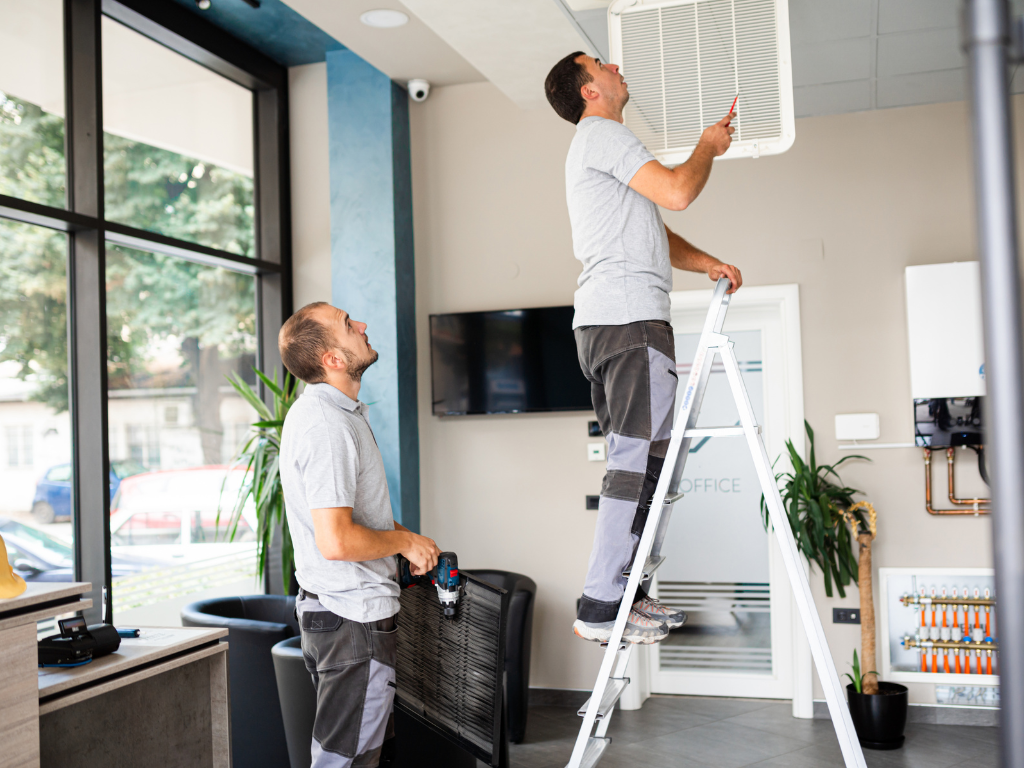
Do I need MCST approval for aircon replacement?
In most condos, yes. Some MCSTs want a full submission with contractor documents. Others just want to know when the work is happening. Ask the management office which applies to you before you book anything.
A typical submission asks for:
- The contractor’s company name, business registration, and public liability insurance
- The new aircon’s brand, model and BTU rating
- Your scheduled work date and how long the job will take
- The piping route, if it differs from what is there now
- Details of any bracket or ledge modification
Budget 3 to 7 business days from submission to approval. Same-day approval almost never happens, so pick your replacement date around the paperwork rather than the other way round.
Skipping it costs more than waiting. MCSTs impose penalties of $300 to $1,500 depending on the bylaws, can order a non-compliant installation removed, and can bill you for restoring the façade. The BCA Strata Management Guides set out where that authority comes from under the Building Maintenance and Strata Management Act.
Like-for-like goes through fastest: same location, same or smaller BTU, same refrigerant. Anything that moves a bracket, adds a unit, or reroutes piping takes longer and gets read more carefully. If you are not sure which category your job falls into, book our aircon inspection for replacement and confirm the scope before you submit.
One shortcut worth asking about: many MCSTs keep a pre-approved contractor list. Use someone already on it and approval often comes back in 1 to 2 business days.
How do I book the lift for condo aircon replacement?
Go through the condo management office, 1 to 3 business days ahead. The fee runs $30 to $50 per session. Your contractor needs the lift for three things: bringing the new equipment up, taking the old units down, and, with cassettes, several trips for parts.
How it usually works:
- Contact the management office, or use the estate’s app or portal if there is one
- Give them the contractor’s company name, the work date, and the expected duration
- Pay the booking fee, normally by bank transfer before they confirm
- Get your slot, usually a 2-hour or 4-hour window
Weekday mornings go first. Book early or you will be scheduling around whatever is left.
The booking covers delivery of the indoor and outdoor units, piping and brackets, removal of the old gear (a wall-mounted indoor unit weighs 10 to 15 kg, an outdoor condenser 30 to 50 kg), and the contractor’s tools and materials.
Replacing several units, or dealing with ceiling cassettes, can mean more than one lift session because of the sheer volume of parts. Some estates make you book waste removal separately from equipment delivery, so check.
Turn up without a booking and security can send the contractor home. A few estates do same-day emergency bookings, but expect $100 to $200 for the privilege.
What are the condo aircon ledge access rules?
Ledge rules cover three things: where your outdoor condenser is allowed to sit, how a technician reaches it, and which orientations the MCST permits. Get any of them wrong and the installation gets rejected at approval, or ordered out afterwards.
Most condensers sit on the AC ledge, the outdoor space the developer built into each unit, reached through a bedroom window or a dedicated ledge door. Some units instead put the condenser on a private balcony, with piping running through the wall, which brings façade rules and bylaws into play. A few older condos have façade-mounted units bolted to the exterior wall, which need MCST approval and a crane hoist whenever anyone services them. Rooftop or common-space placement shows up mainly on premium ducted systems and rarely in modern residential blocks.
What each placement does to your service bill:
- AC ledge: nothing extra. The technician reaches it from inside the unit.
- Balcony above the 8th floor: the technician needs a safety harness, which adds $20 to $30.
- Façade-mounted: scaffolding or a crane hoist, adding $200 to $500.
- Rooftop: access is MCST-managed and the contractor has to coordinate with building maintenance staff.
Some bylaws also dictate orientation: which way the unit faces relative to your neighbours, how far it must sit from the railing, which way it drains. And moving a bracket within the ledge, or shifting the condenser from balcony to ledge, counts as a modification. That needs formal approval, and if the façade changes, you may be paying to restore it.
What after-hours work restrictions apply in condos?
Two sets of rules apply at once: the national NEA noise hours and your estate’s own bylaws. When they disagree, the stricter one wins.
The NEA guidance on noise from renovation work in residential areas sets the national baseline: general work from 9am to 6pm on weekdays and Saturdays, noisy work like drilling and hammering from 9am to 5pm on weekdays only, and no noisy work at all on Sundays or public holidays.
Estates then narrow it further. Luxury condos in Districts 9, 10 and 11 commonly allow work from 10am to 5pm on weekdays with no weekend work, and restrict drilling to 11am to 4pm. Standard condos usually run 9am to 6pm on weekdays plus Saturday morning. Older estates can be more relaxed, sometimes allowing a full Saturday. Serviced apartments set their own rules through the lease.
Your management office or the bylaws document has the specifics, and the contractor should check before proposing a date.
That window shapes the schedule more than most owners expect. A System 4 with ceiling cassettes needs more hours than a 4 to 6 hour daily window allows, so the job runs across two days. If your estate permits Saturday work, expect a 20% to 30% surcharge for it, covering the scheduling juggle and staff overtime.
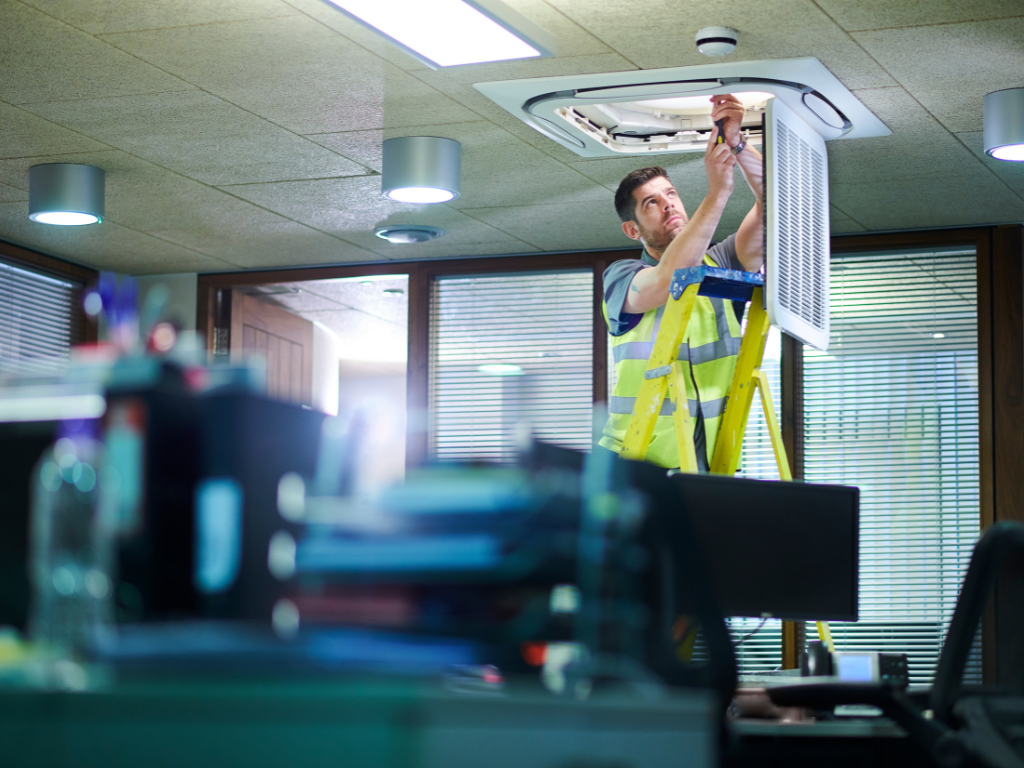
Are ceiling cassettes harder to replace in condos?
Yes, and by a wide margin. A cassette replacement costs 20% to 40% more than the wall-mounted equivalent and takes 50% to 100% longer, adding $400 to $1,000 to the bill.
The work itself explains why. The technician takes down the ceiling panel, usually 4 to 8 screws, and puts it back at the end. Everything happens overhead from a ladder or step platform, including the piping connections, which are far more awkward at ceiling height than at chest height. Dropping the old cassette and lifting the new one needs two technicians working together. And if the ceiling panel gets damaged coming down, someone has to restore the opening.
What each type adds over a wall-mounted unit:
- 4-way surface cassette: $400 to $700
- 1-way concealed cassette: $600 to $1,000
- Ducted with ceiling access panel: $800 to $1,500
Time-wise, budget 5 to 8 hours for a cassette against 3 to 5 hours for wall-mounted. Several cassettes in one condo often means two days.
Newer condos built after 2015 tend to use modular cassette systems that come out cleanly. Legacy cassettes in older estates are the ones that produce surprises, so if yours is concealed with restricted access, get our aircon installation and replacement team to assess feasibility before anyone quotes a fixed price.
What does condo aircon replacement cost vs HDB?
Expect to pay $200 to $800 more than the same job in an HDB flat. The gap covers MCST admin, the lift booking, cassettes, façade compliance, and access fees at the premium end.
Mid-tier inverter systems, 2026 rates:
| System | HDB | Condo | Difference |
| System 2, wall-mounted | $1,400 to $1,800 | $1,600 to $2,100 | +$200 to $300 |
| System 3, wall-mounted | $1,800 to $2,400 | $2,100 to $2,800 | +$300 to $400 |
| System 4, wall-mounted | $2,400 to $3,000 | $2,800 to $3,500 | +$400 to $500 |
| System 3 with 1 cassette | $2,200 to $3,000 | $2,700 to $3,800 | +$500 to $800 |
The line items behind that premium:
- MCST admin fee, where charged: $30 to $100
- Lift booking: $30 to $50 per session
- Premium residential access fee at luxury condos: $50 to $150 per visit
- Ceiling cassette uplift: $400 to $1,000 per unit
- Façade compliance work such as trunking and colour matching: $100 to $300
- Saturday or evening work surcharge: 20% to 30%
- Crane hoist for façade-mounted disposal, rare: $200 to $500
District 9, 10 and 11 addresses with tight work windows and strict MCST processes can add another $200 to $400 on top of all that.
Two things pull the other way. Replacing several units at once qualifies for multi-unit discounts, usually 10% to 20% off base rates. And negotiating contract servicing at the same time can absorb some of the administrative overhead the contractor would otherwise bill you for.
What piping considerations apply to resale condos?
Buying a resale condo means inheriting whatever piping the previous owner had. Anything installed before 2013 likely ran R22, with mineral oil residue in the lines. Putting an R32 system onto that piping means either replacing it or flushing and pressure testing it thoroughly.
What to expect by the age of the building:
Pre-2000. Legacy R22, mineral oil residue, piping now 15 to 25 years old. Plan on replacing it. Cost runs $100 to $500 depending on the run length.
2000 to 2013. A mixed period of R22 and R410A. Someone has to check which you have. R22 means new piping. R410A usually means you can reuse it after a nitrogen flush.
2013 to 2018. Mostly R410A. The piping is normally reusable after a pressure test and flush, at $80 to $200.
Post-2018. R32 by default, and the piping reuses in most cases with a standard pressure test.
Anything built from 2015 onward often runs piping through the ceiling void or concealed trunking, which is far more involved to replace than an exposed run. Get it assessed before the quote is fixed.
A pressure test confirms both the condition of the piping and its refrigerant compatibility before you authorise the replacement. It costs $60 to $150 on a typical condo installation, which is cheap next to discovering a problem mid-job.
Four things turn up repeatedly on resale condo piping: corroded fittings that need replacing even when the copper itself is sound, insulation that has broken down after years in tropical humidity, piping undersized for the larger unit you want to install, and concealed runs nobody can inspect until a wall comes open.
Budget accordingly. A pre-2013 resale condo with confirmed R22 running a System 3 comes to $2,800 to $3,800 with piping replacement included, against $2,100 to $2,800 for a straightforward R32-to-R32 swap. If the existing unit is under 5 years old with a single-point leak, repairing it may beat replacing it, and our aircon repair services cover that route.
How is the old unit disposed from a high-rise condo?
Almost always down the service lift. Crane hoists only come into it for façade-mounted units in older estates. Disposal costs anywhere from $30 to $500 depending on what you have and how it comes out.
Down the service lift:
- Wall-mounted indoor unit at 10 to 15 kg, one trip
- Outdoor condenser at 30 to 50 kg for a residential system, one trip
- Combined disposal fee including the lift booking: $30 to $80
Cassettes and ducted units:
- Ceiling cassette at 12 to 18 kg, possibly several trips if you have three or more
- Ducted evaporator at 25 to 40 kg, which needs a larger trolley
- Combined disposal fee: $60 to $150
The awkward cases:
- Façade-mounted condenser in an older condo: crane hoist, MCST approval for the crane setup, and $200 to $500 including the crane rental share
- Rooftop unit: coordinated with MCST maintenance staff, $100 to $250
Whatever the route, the refrigerant comes out first. R22, R410A and R32 all have to be recovered before disposal, and NEA rules require certified recovery for R22 under Montreal Protocol controls. Your contractor needs an NEA-certified refrigerant handler on the team, so ask.
There is money coming back the other way. The outdoor unit holds recoverable copper and steel, and some contractors credit $20 to $80 of that against your replacement cost. If yours does, it should be a line on the quote rather than something you have to ask about.
A few premium estates will not let contractors use the public lifts for disposal at all, which means booking the dedicated service lift or freight elevator, sometimes with an escort. Add $30 to $50.
What to sort out before you book the contractor
Replacing an aircon in a condo runs $200 to $800 above the HDB equivalent, and the reasons are administrative rather than technical: MCST approval taking 3 to 7 business days, lift bookings, ceiling cassettes, façade bylaws, and work windows your estate sets. Buying resale changes the maths again. A pre-2013 unit still on R22 adds $500 to $1,000 for piping replacement on top of everything else.
Book a pre-quote assessment with SACES and we cover what you need before the MCST paperwork goes in: whether your submission is ready, what condition the piping is in, whether the ceiling cassette can actually be swapped without opening the ceiling, and the lift booking through your management office.
FAQs About Condo Aircon Replacement
Do condo façade rules affect where the outdoor unit goes?
Yes. Most bylaws require the condenser to sit on the designated AC ledge, out of sight from public areas, oriented the same way as everyone else’s. Moving it to a balcony or mounting it on the façade usually needs MCST approval, and installing it without approval can mean paying to restore the building and remove your unit.
Is there a premium residential access fee for condo aircon service?
At luxury condos, yes. Districts 9, 10 and 11 residences and premium serviced apartments charge $50 to $150 per contractor visit for building administrative overhead. Standard estates rarely do. It sits on top of the lift booking fee rather than replacing it, so check with the management office before you authorise anything.
How long does condo aircon replacement take vs HDB?
Around 6 to 10 hours in a condo once you account for the admin, the lift and any cassette work, against 4 to 8 hours in an HDB flat. A System 2 or System 3 with wall-mounted units finishes in a day. A System 4, or anything with several cassettes, often needs two days in an estate with a short work window.
Can I do aircon replacement in a condo without MCST approval?
No. Penalties typically run $300 to $1,500, the MCST can order a non-compliant installation removed, and you pay to restore anything affected. Those enforcement powers come from the Building Maintenance and Strata Management Act. For a like-for-like replacement the approval is routine anyway, so budget the 3 to 7 business days and submit.
What happens if the resale condo has R22 piping I didn’t know about?
You either replace the piping or flush it thoroughly before an R32 system goes on, which adds $100 to $500 depending on the run length. The contractor should identify the refrigerant at the pre-quote inspection rather than on the day. If it surfaces mid-installation, work stops, the cost gets discussed, and you sign off on a revised quote before anyone carries on.