Why Is My Aircon Leaking Water Singapore? Diagnosis

Why is my aircon leaking water Singapore households ask when condensation drips on the bed at 2am. The drip pattern tells you the cause. Roughly 60-70% of cases are clogged drain pipes; the rest split between drain misalignment, insulation failure, and refrigerant-related coil freeze. This blog walks you through the diagnostic framework, costs, and HDB drainage rules behind every fix, anchored to aircon leak repair and troubleshooting.

What’s actually leaking? The drip location decodes the cause

Where the water comes from is the most reliable cause indicator. The drip pattern follows physics: water falls along the path of least resistance, and that path reveals what went wrong inside the unit. Front louvre drip means drain pan overflow. The pan inside the indoor unit fills past capacity and water pours forward. Cause: blocked drain line, roughly 60-70% of cases. Side seam drip means the unit is mounted unlevel or the drain pan has cracked. Less common, around 5-10% of cases. Back wall stain (water visible on the wall behind the unit) means drain pipe failure inside the wall cavity. Causes: pipe joint break during a previous renovation, sagging due to age, or rodent damage in older installations. Drip from the outdoor end of the drain pipe is normal when the unit is running. This is condensate doing what it should do. Worry only if the drip stops (clog forming) or if water appears at the wrong end (front). Coil freeze leak has a distinct pattern: dripping from the front when the unit is OFF, after a period of running. The frozen evaporator coil thaws and water that bypassed the drain pan falls. What's actually leaking? The drip location decodes the cause

Why is my aircon leaking water from the front?

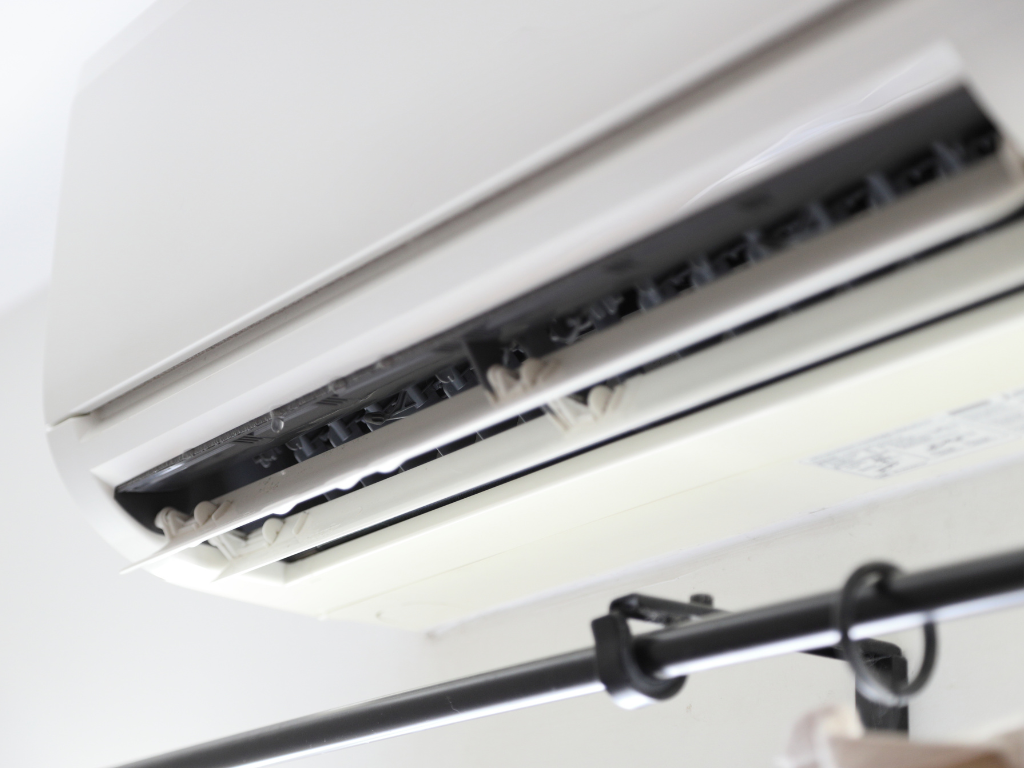
Front-louvre water is drain pan overflow in 95% of cases. The condensate that should leave through the drain pipe instead backs up inside the indoor unit and spills forward through the slats. Three things block the drain line. Algae sludge biofilm grown inside the pipe accounts for around 70% of cases. Dust and debris from servicing residue accounts for around 15%. Mineral deposits from condensate reacting with cleaning residue accounts for around 10%. Diagnosis is fast. Pour 500ml of water into the drain pan. Watch it. If it doesn’t drain within 30 seconds, the line is blocked. If it drains slowly, partial clog. If it drains fast, the problem is elsewhere (mounting level, pan crack). Algae grows faster in Singapore than in temperate countries because the drain pipe stays wet year-round, with 80% relative humidity ambient and 12-15°C condensate water passing through daily. The signs an aircon needs a chemical wash in Singapore lists drainage symptoms alongside smell because the same biofilm that produces musty odour also clogs the line. Cost: drain line clearance runs $80 to $150 in 2026. Severe clog requiring drain pipe replacement runs $250 to $400. Why is my aircon leaking water from the front?

Why is my aircon leaking from the side or back?

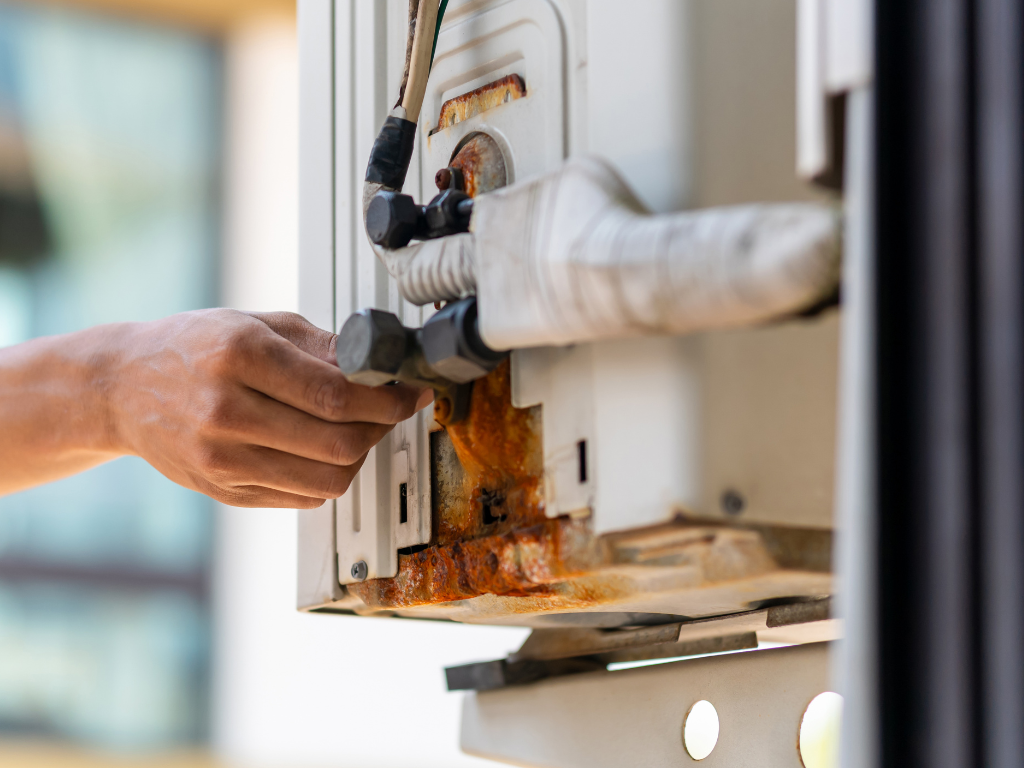
Side or back leaks point to installation or insulation problems, not maintenance. Side seam leaks happen when the indoor unit is mounted at the wrong angle. The fan coil needs a slight tilt toward the drain side so gravity pulls water that way. If the unit is mounted level or tilted away from the drain, water collects on the wrong side and seeps through the seam between front housing and back plate. Back wall stains point to a broken drain pipe inside the wall cavity. Causes: pipe joint break during a previous renovation, rodent damage in older installations, or insulation degradation that allowed condensation on the pipe itself. Insulation failure on the refrigerant lines (the copper pipes between indoor and outdoor units) causes condensation on the pipes themselves. The pipes drip wherever the foam insulation has degraded or come loose. Drip pattern: random locations away from the indoor unit, sometimes inside ceiling cavities or wall chases. Repair requires partial wall opening to re-lag the pipes, typically $200 to $500.

Why is my aircon dripping suddenly when it never did before?

Sudden onset leaks almost always have a recent trigger. Three triggers are common in Singapore homes. The unit was serviced recently. Drain line debris dislodged during cleaning may settle in a low spot. The drain pan may not be seated correctly. Foam insulation may have been knocked loose during dismantling. Ambient temperature has risen sharply. Condensate volume can triple between cool February (15-20L per day for a typical 12,000 BTU HDB unit) and hot May (35-50L per day). A drain line that handled cool-month volume can overflow at hot-month volume if it has any partial clog. The Meteorological Service Singapore climate overview confirms May and June consistently among the hottest and most humid months of the year. A new piece of furniture is blocking airflow. Reduced airflow over the coil means slower evaporation, more condensate, faster pan filling. If the unit shows no cold air alongside the sudden drip, the cause is usually coil freeze from low refrigerant. The diagnostic checklist when an aircon is not cold covers the cooling-failure side of this combined symptom. Worth noting: the absence of a recent trigger combined with a sudden leak usually points to drain line algae growth that has been building for months and finally reached blockage threshold.

Why is my aircon leaking water right after servicing?

Leaks within 7 days of a service are usually caused by the service itself. Most Singapore contractors skip the post-service water-pour test that catches this before the technician leaves. Three causes account for most “leaking after servicing” complaints. The drain pan was not reseated correctly. There’s usually a tab or clip that secures the pan to the housing. Missing the reseat means the pan sits at a slight tilt and water spills. The drain line wasn’t flushed during service. Servicing dislodges biofilm inside the unit, and the loose debris travels into the drain line and settles at the first bend, creating a clog the unit didn’t have before. The general aircon servicing standard scope should include drain line flushing for exactly this reason. The drain pan rubber gasket compressed and wasn’t replaced. After 5+ services on the same unit, the gasket stops sealing. A reputable contractor includes gasket replacement when wear shows; budget contractors skip it to keep cost down. The cleaner approach: if a leak appears within 7 days of a service, the contractor who did the work should return at no charge to investigate. Document the timing in writing. If they refuse, document the refusal and engage a different contractor for a chargeable inspection.

What does brown or muddy water from the aircon mean?

Brown water means the drain line has established biofilm that is now dislodging. The water mixes with algae sludge as it passes through the pipe and picks up the brown-green colour. The clog will progress to full blockage within weeks if untreated. Black flakes in the water mean mould has broken loose, often after a recent chemical wash or general service partially dissolved the biofilm without flushing it out. The fix is a deeper line flush plus chemical wash on the evaporator coil itself. Cloudy white water is usually mineral deposits from cleaning residue reacting with humid condensate. Less serious, but signals incomplete rinsing during the previous service. Clear water with strong musty smell means biofilm is well established and producing volatile compounds. Chemical wash is overdue. The water test is more reliable than people assume. Catch a tablespoon of the drip in a clear glass. Hold it up to light. Colour and content tell you the urgency.

Is aircon water leak dangerous?

Water leaks become dangerous when they reach electrical components, breed pathogens, or saturate ceiling materials. Three risk categories. PCB water risk. The printed circuit board sits inside the indoor unit housing. Water reaching the PCB shorts the control electronics and triggers fault codes or total unit failure. PCB replacement runs $250 to $550. Switch off the aircon at the MCB if water has reached the housing interior. Pathogen risk in standing condensate. The US CDC guidance on controlling Legionella in HVAC devices sets Legionella growth range at 25–45°C, with growth possible as low as 20°C. A choked drain pan holding condensate at room temperature falls inside that range. The CDC explicitly lists keeping condensate pans clean and free from biofilm as a primary prevention step. Singapore aircon drain pans that haven’t been chemically washed in 18+ months are exactly the environment described. Ceiling damage from sustained leakage. A leak ignored for 3+ weeks can saturate gypsum ceiling boards in cassette installations. Restoration cost: $400 to $800 plus the underlying drainage repair.

What does HDB say about aircon condensate drainage?

HDB requires aircon condensate to discharge into an internal floor trap, not onto external balcony floors or out a wall to the public realm. The HDB MyNiceHome guidance on aircon maintenance for home owners states condensation water must be properly discharged into a nearby internal drainage opening to prevent inconvenience to lower-floor neighbours or passers-by. Many older installations route the drain pipe through a wall and let condensate drip outside. This violates HDB rules. If a neighbour complains, HDB can require remediation at the unit owner’s expense. For renovated HDB units, an internal drain routing to the bathroom or kitchen floor trap is the standard compliant solution. The internal route also clogs less than external routing because it’s protected from leaf debris and insects. For BTO units built after 2015, internal floor trap routing is the default installation method, with the external wall opening reserved for refrigerant pipes and electrical only. Owners of older HDB units should check their installation against this standard during the next home aircon servicing visit.

How much does it cost to fix an aircon water leak in Singapore in 2026?

Repair cost depends on the cause. Most water leak fixes cost under $200; the expensive scenarios involve PCB damage or pipe replacement.
Cause Repair cost (2026)
Drain line clearance (clog) $80 to $150
Drain line replacement $250 to $400
Drain pan replacement $180 to $300
Drain pan reseating after improper service $0 to $80 (contractor warranty work)
Condensate pump replacement (cassette only) $180 to $280
Insulation re-lagging on concealed pipe $200 to $500
Refrigerant leak repair plus recharge $250 to $450
PCB replacement after water damage $250 to $550
For diagnostic visits before committing to a fix, a professional aircon inspection service runs $60 to $120 per system with a written report covering drain pan, line, and electrical condition. Refrigerant-related leaks require NEA-licensed handling through the aircon gas top-up service because R32 and R410A cannot be added or recovered by unlicensed installers. Where this breaks down is for sustained leaks ignored beyond 3 weeks. A $120 drain clearance turns into a $600 PCB plus ceiling restoration once the water has migrated to electronics or downstairs neighbours.

Conclusion

Aircon water leaks in Singapore are diagnosable by drip pattern faster than by guesswork. Front-louvre drip means drain pan overflow. Side-seam drip means mounting or installation issue. Back-wall stain means in-wall pipe damage. Dripping when off after running means coil freeze. Brown water means established biofilm. HDB rules require internal floor trap discharge. Book an aircon inspection with SACES for any leak that has lasted more than 48 hours, and you’ll get a per-cause diagnosis plus a written quote before any repair work begins.

FAQs About Why is My Aircon Leaking Water Singapore

Why does my aircon drip more in hot weather?

Condensate volume rises with humidity, and Singapore’s relative humidity stays above 80% from April through June. A 12,000 BTU unit can produce 35 to 50 litres of condensate per day in hot months versus 15 to 20 litres in cool months. Any partial drain line clog overflows at the higher volume.

Can a dirty filter cause aircon to leak water?

Yes, indirectly. A choked filter reduces airflow over the evaporator coil. The coil temperature drops too low, ice forms on the surface, and when the unit cycles off the ice thaws and produces water beyond drain pan capacity. Wash filters monthly to prevent the cascade. The whole effect costs nothing to prevent.

Why does my aircon leak water only when off?

This is the coil freeze pattern. Low refrigerant or restricted airflow causes the evaporator coil to ice over while running. Ice thaws after shutdown and produces a sudden release of water that overflows the drain pan. Common in units 5+ years old with slow refrigerant leaks. Refrigerant top-up plus leak repair usually resolves it.

Is brown water from aircon harmful?

Brown water indicates established biofilm and mould inside the drain line and possibly the evaporator coil. The CDC notes that biofilm in HVAC condensate components supports pathogen growth at 20-45°C, which covers Singapore room temperatures. A chemical wash on the affected unit is recommended within 2-3 weeks.

Will my aircon fix itself if the leak stops?

No. If a leak stops without intervention, the drain line has typically dried with the clog fully sealed inside. The next time the unit runs at high cooling demand, the leak returns worse. Address the leak while the diagnosis is straightforward and the repair stays under $200.