Aircon Gas Leak Signs: Why Pressure Test Comes First
Aircon gas leak signs Singapore homeowners miss until cooling drops. Refrigerant is a sealed fluid; if escaping, there’s a leak. Oil residue at flare joints, hissing near the outdoor unit, and patchy ice on copper piping are the earliest signs. System 4 configurations mean 4x the leak sites. This blog walks you through the signs and the nitrogen pressure test, anchored toaircon gas top-up and leak repair.
What are the signs of aircon gas leak?
Aircon gas leak has three sign categories: visual (oil residue at joints, patchy ice on copper pipes), audible (hissing at connections), and thermal (weak cooling, delta-T below 8°C, uneven cooling across rooms). Any one of these on its own is worth checking; two or more together confirms a leak with high probability.Visual signs are the most reliable in Singapore because our humidity accelerates corrosion patterns. Oil residue at flare joints signals refrigerant carrying compressor oil out through the leak. Green corrosion on copper indicates active moisture ingress plus refrigerant escape.Audible signs are subtle. Refrigerant leaves the system as a slow gas escape; the sound is a soft hiss, not a clear whistle. Hissing at the outdoor unit’s flare connections or at wall penetrations where copper enters the room is the most common location.Thermal signs come last and are least reliable on their own. Weak cooling can also mean dirty filter, dirty coil, or thermostat setting. Weak cooling that returns weeks or months after a previous gas top-up is the strongest leak signal in the thermal category.For any of these, theprofessional aircon inspection service covers a full diagnostic before recommending refrigerant work.
Why does oil residue at flare joints mean a gas leak?
Oil residue at flare joints is the clearest visual leak sign. Refrigerant carries a thin film of compressor lubricant oil throughout the system. When refrigerant escapes at a joint, the oil deposits on the surrounding metal and creates a visible residue.The oil residue appears as a dark brown or amber film around the flare nut. Fresh residue is oily to touch; older residue attracts dust and looks like a dry crust.Common inspection points: the flare joints at both ends of the copper piping (where it connects to indoor and outdoor units), the schrader valves at the outdoor unit, and any brazed joints visible along the piping run.A photograph of the residue with a phone camera is often enough for a technician to prioritise that joint as a leak candidate before pressure testing. Theprofessional aircon pressure test then confirms whether the residue represents an active leak or a repaired historical leak.Worth noting: on units older than 8 years, small amounts of oil residue at flare joints can accumulate from micro-leaks that don’t affect cooling performance. Actionable leaks show a clear pool or crust, not just a faint film.
What does a hissing sound from the aircon indicate?
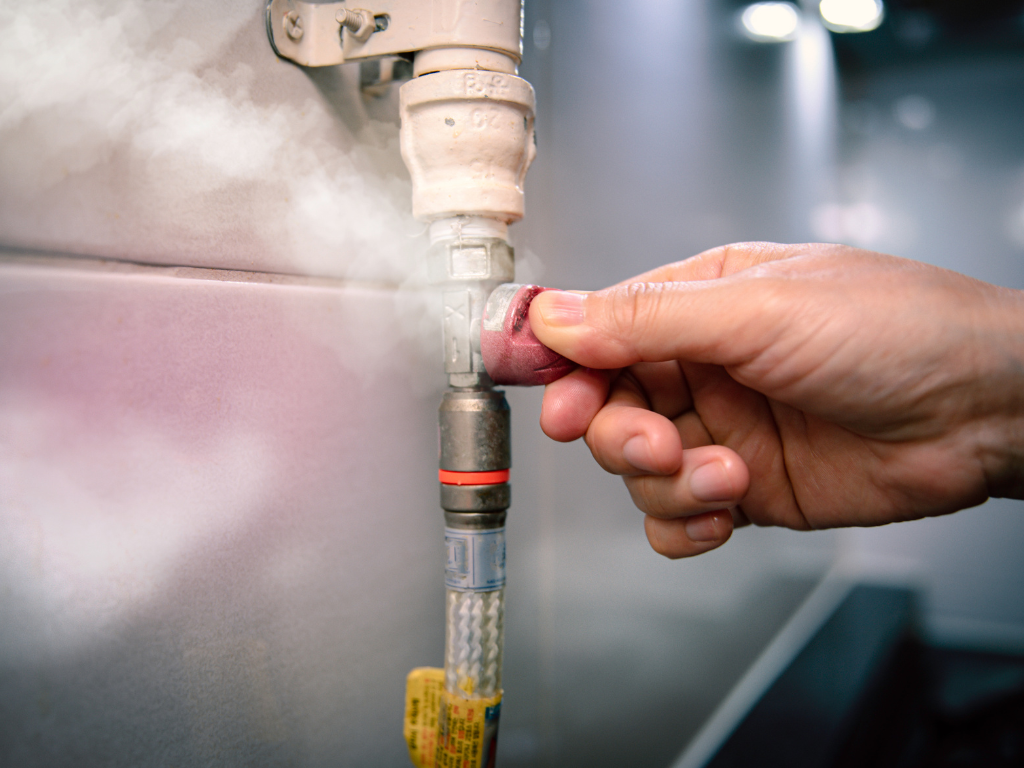
Hissing from an aircon usually indicates refrigerant escape from a joint or crack. Locate the sound to identify the leak point.Hissing at the outdoor unit is most common. Flare joints where the piping enters the condenser can loosen over time, especially on units 8+ years old. The escape happens under running pressure (roughly 100-150 psi on R32 systems), which makes the sound audible at 30-50 cm distance from the joint.Hissing at the wall penetration inside a room usually indicates a leak in the piping trunking behind the wall. This is harder to locate and often requires theaircon repair and troubleshooting service to open access panels.Hissing at the indoor unit (fan coil) can also indicate refrigerant leak at the evaporator coil connection, though this is less common. Distinguish from expected sounds: the click of a compressor relay, the whoosh of blower start, and the gentle water gurgle of drain flow are all normal.A distinctly high-pitched whistle usually indicates a pressure release from the schrader valve or a partially closed service valve, not a leak; this is a service issue rather than a gas leak. Sustained soft hissing over hours or days is the leak signal.
What is a System 4 aircon and why is pressure test essential?
A System 4 aircon is a Singapore-specific configuration with 1 outdoor condenser unit connected to 4 indoor fan coil units, typical in condominium and landed housing installations. System 2, System 3, and System 5 are variants with 2, 3, and 5 indoor units respectively.The pressure test is more essential on System 4 than single-split systems because there are 4x the flare joints, 4x the piping runs, and 4x the brazed joints inside trunking bends. A leak on any of the 8+ flare connections drains the entire system’s refrigerant.Common System 4 configuration: living room 24,000-30,000 BTU indoor unit plus 3 bedroom 9,000-12,000 BTU indoor units, all fed from a single 5-6 HP outdoor condenser. Each indoor unit has 2 flare joints (liquid line + gas line), giving 8 total joints just at the indoor ends.Cooling asymmetry is the giveaway diagnostic. If 3 of 4 rooms cool normally but the 4th cools weakly, the leak is on that zone’s individual line rather than the shared trunk line. If all 4 cool weakly, the leak is on the shared trunk or the outdoor unit.Nitrogen pressure test on a System 4 is more time-consuming than on a single-split system, typically 60-90 minutes vs 30-60 minutes on a single split, because more piping and joints need to hold pressure simultaneously.
What is a nitrogen pressure test and how does it work?
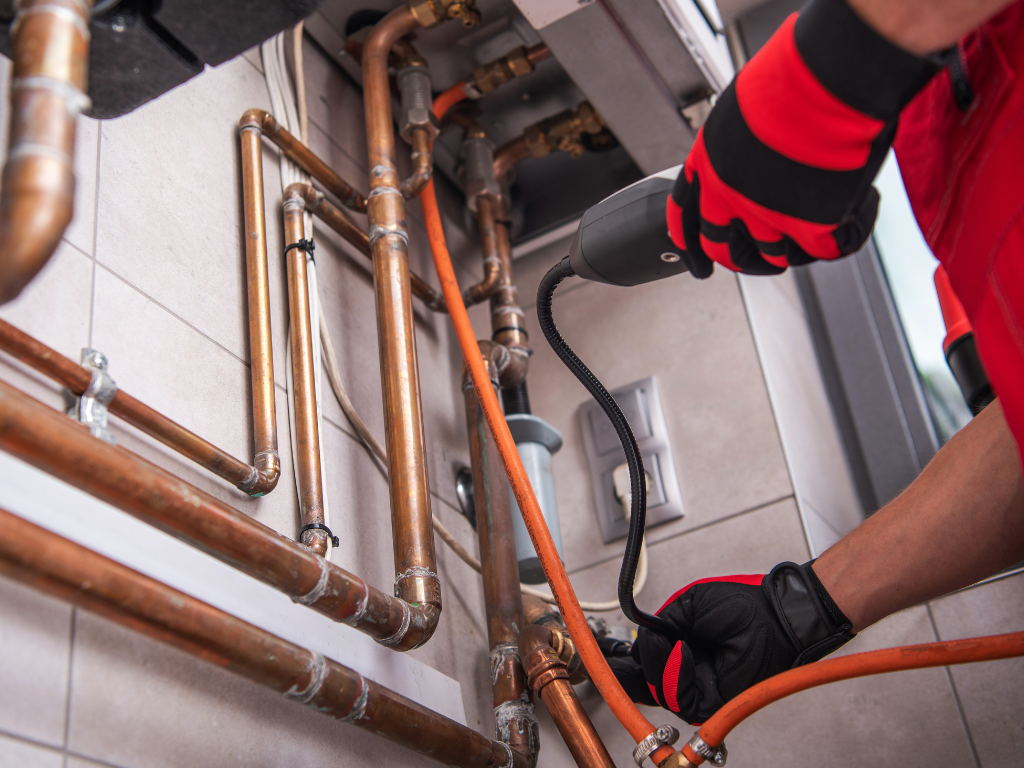
Nitrogen pressure test is the standard leak detection procedure for aircon refrigerant systems. The technician charges the system with dry nitrogen (typically 300-500 psi) after refrigerant is recovered, then monitors pressure decay over time.Standard procedure: evacuate the system, connect a nitrogen cylinder via gauge manifold, pressurise to test level, close valves, and observe. A leak-free system holds pressure steady within ±5 psi over 24 hours (allowing for ambient temperature variation). Pressure drop of 20+ psi in 24 hours confirms a leak.Leak location is then identified by soap solution application at joints (bubbles form at the leak point) or electronic leak detector wand. For concealed brazed joints inside trunking, the leak location is inferred from decay rate on isolated sections.Test cost in Singapore in 2026: $80 to $180 depending on system complexity. System 4 tests run at the higher end due to more joints requiring simultaneous testing.After leak repair, a second pressure test confirms the seal held. Skipping the post-repair test is common contractor corner-cutting; without it, the “repair” may not have actually worked.Vacuum hold test complements pressure test on the low-pressure side: evacuate to 500 microns Hg, hold for 15-30 minutes, verify no pressure rise. This confirms no moisture or micro-leak on the sealed side.
Where do most Singapore aircon gas leaks happen?
Six locations account for the majority of Singapore aircon refrigerant leaks. Ordered by frequency:Flare joints at outdoor unit: vibration and thermal cycling loosen the flare nut over years. 8-10 year old units are the peak leak age at this location.Flare joints at indoor unit: less common than outdoor because indoor conditions are more stable, but installation-defect flares (over-torqued or under-torqued) fail earlier.Evaporator coil (indoor): aluminum fin corrosion after 8-12 years. Pinhole leaks develop where humidity and dust have concentrated on the coil surface.Condenser coil (outdoor): copper tube corrosion in coastal or heavily polluted air. HDB units near industrial areas or coastal condos are at higher risk.Brazed joints inside trunking bends: installation-quality dependent. Under-brazed joints fail within 3-5 years; well-brazed joints last decades. Concealed location means detection requires pressure test.Schrader valve at outdoor unit: wear from repeated servicing. Common on units serviced by multiple contractors over years.For prevention, routine aircon servicing inspects visible joints during each visit; hidden leaks require the pressure test as a separate service. High-quality aircon installation with proper torque wrench on flares and controlled brazing on hidden joints reduces long-term leak probability significantly.
Should I repair the leak or replace the unit?
Repair the leak if the unit is under 10 years old and the leak location is accessible. Consider replacement if the unit is 10+ years old with multiple leak points, or if the leak is on the evaporator or condenser coil itself where repair approaches partial replacement cost.Repair cost for a flare joint leak: $150 to $300 including pressure test and refrigerant recharge.Repair cost for a brazed joint leak: $250 to $450 depending on access difficulty.Repair cost for a coil leak: $400 to $800 for evaporator, $500 to $900 for condenser. On units over 10 years old, unit replacement at $700 to $1,400 often makes more sense than coil repair.Repeat leaks on the same unit suggest either persistent installation defect or systemic aging. If a unit has needed leak repair twice within 3 years, budget for replacement in the near term.TheUS EPA guidance to homeowners on refrigerant recommends leak repair over topping off for environmental and long-term cost reasons; this applies equally to Singapore residential systems.
Conclusion
Aircon gas leak in Singapore is diagnosable by visual, audible, and thermal signs before it becomes a full cooling failure. Oil residue at flare joints, faint hissing near connections, and patchy ice on copper piping are the earliest markers. System 4 configurations complicate detection because 4x the joints mean 4x the potential leak sites, which is why the nitrogen pressure test is essential rather than optional. Repair the leak, don’t just top up the refrigerant.Book a nitrogen pressure test with SACES for any leak signs on your unit, and you’ll get exact leak location and repair scope before any refrigerant work is authorised.
FAQs About Aircon Gas Leak Signs
How much does an aircon pressure test cost in Singapore?
Pressure test costs $80 to $180 in Singapore in 2026 depending on system complexity. Single-split systems test at the lower end; System 4 configurations run $150 to $180 due to more joints requiring simultaneous testing. Cost usually includes leak location using nitrogen and soap solution or electronic leak detector wand, with written findings.
Can I use my aircon while waiting for leak repair?
Not recommended. Running an aircon with a slow leak accelerates leak growth, wastes refrigerant into the atmosphere, and reduces compressor life by 20-40% due to sustained low-refrigerant operation. Turn off the unit until pressure test and repair are complete. This is typically a 24 to 48 hour turnaround, minimal disruption.
How long does aircon leak detection take?
Pressure test and leak location take 30 to 90 minutes for single-split systems and 60 to 120 minutes for System 4 configurations. Add 24 hours for the pressure hold test on suspected slow leaks. Total time from booking to repair recommendation is typically 1 to 3 days on a standard residential system.
Is a hissing sound always a gas leak?
Usually. A sustained soft hissing sound at joints or piping is refrigerant escape in most cases. Exceptions: a click-hiss on compressor start is normal contactor operation; a whistle at the service valve is pressure release, not a leak; and water gurgle in the drain line is expected. Distinct location and continuous sound point to leak.
What causes aircon copper piping to corrode?
Copper corrosion on aircon piping in Singapore is accelerated by high humidity (80% year-round), coastal salt air on units near the sea, and chemical exposure in industrial-adjacent HDB blocks. TheSingapore refrigerant handling framework under NEA covers the environmental context; localised corrosion requires physical replacement of affected piping sections.