
HDB aircon replacement in Singapore covers 80% of the residential aircon market. The rules for HDB differ from condo in three specific ways: no MCST needed but Town Council notification varies, HDB-approved brackets must meet specifications, and like-for-like replacement doesn’t require an HDB permit. This blog walks you through ledge rules, piping reality, and 2026 cost by flat type, anchored to professional aircon installation and replacement.
What’s different about HDB aircon replacement vs condo?
HDB aircon replacement differs from condo replacement in four specific areas: administrative process, bracket specification, drainage rules, and Town Council instead of MCST notification. The technical scope (unit swap, piping, refrigerant, isolator) is otherwise the same.
Administrative process: HDB doesn’t require a formal permit for like-for-like aircon replacement. Condo replacement often needs MCST notification and lift booking. HDB is administratively simpler.
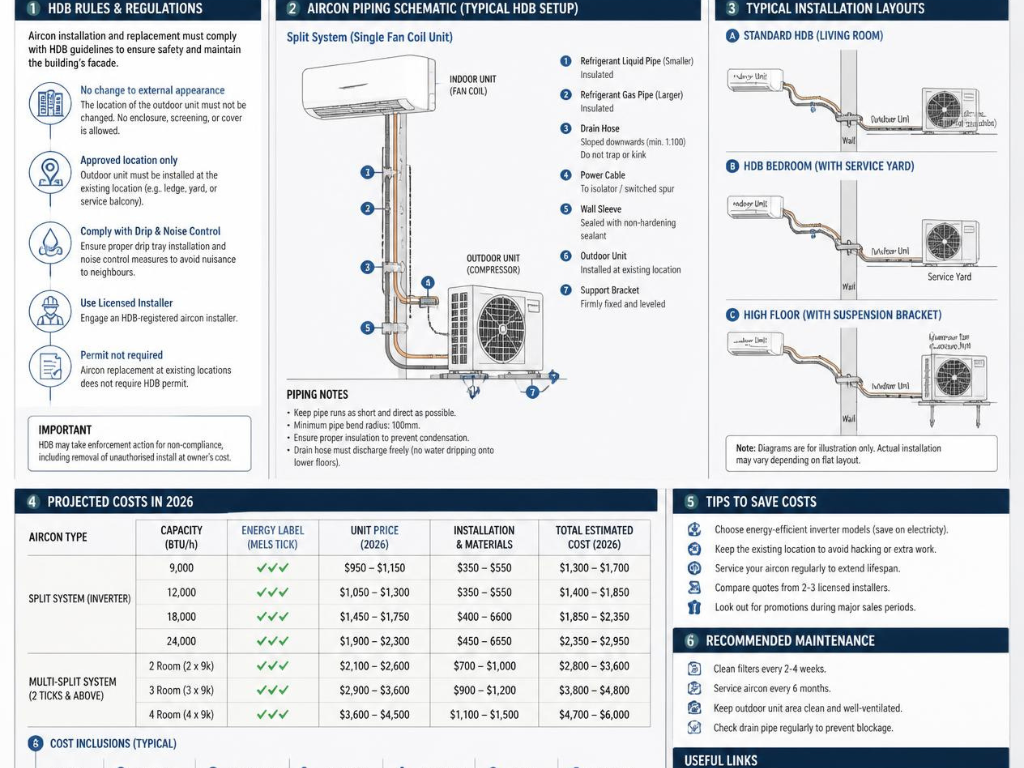
Bracket specification: HDB has specific safety requirements for outdoor unit brackets (hot-dip galvanised or stainless steel, sized 20-45 kg condenser, expansion bolts to concrete). Condo bracket rules are set by individual MCST bylaws.
Drainage rules: HDB requires condensate to discharge into an internal floor trap, not out to external ledges. Condo rules vary by building; some allow external discharge to designated drain lines.
Notification: HDB residents may need to inform their Town Council for scheduled contractor work; some estates require it, others don’t. Condo residents notify their MCST.
Cost: HDB and condo replacement pricing is similar for equivalent system sizes, though HDB access complications (ledge reach, older wiring) can add $100-$300 in remediation. The general aircon replacement guidance covers pricing across both contexts.
Do I need HDB approval for aircon replacement?
No HDB permit is required for like-for-like aircon replacement in an HDB flat. Like-for-like means the new unit replaces the old at the same bracket location with the same or smaller BTU capacity. Non-like-for-like changes require HDB approval.
Like-for-like scope (no permit needed):
- Replacing an existing 9,000 BTU indoor unit with a new 9,000 or 12,000 BTU unit at the same wall location
- Replacing the outdoor condenser at the existing bracket location (same or smaller physical size)
- Reusing the existing piping route (concealed or exposed)
- Using an HDB-approved bracket
Non-like-for-like scope (HDB approval typically required):
- Installing an additional indoor unit not present in the original setup
- Relocating an existing indoor unit to a different room
- Installing an outdoor condenser at a new ledge location or different bracket position
- Upgrading electrical capacity (main DB box scope) beyond the current supply
Non-like-for-like changes are handled by submitting a request through the HDB Home Improvement Programme application or through direct HDB engagement, depending on the specific change. Standard contractor knowledge covers most cases.
For units where the replacement scope is uncertain, the professional aircon inspection service can clarify whether HDB permit engagement is needed before the replacement job starts.
What’s the like-for-like replacement rule?
Like-for-like rule permits HDB aircon replacement without permit engagement when: the new indoor unit location matches the old, the new BTU is equal or smaller than the old (some interpretations allow same-type upgrade to slightly larger BTU within the same wall footprint), and the outdoor bracket location is unchanged.
The rule’s purpose: differentiate routine appliance replacement (like swapping a fridge for a new fridge) from renovation work (structural changes requiring building compliance review).
Common interpretations:
Same location, same BTU, same refrigerant type: definitively like-for-like, no permit.
Same location, upgrade from 9,000 to 12,000 BTU: usually accepted as like-for-like if wall structure and electrical supply accommodate. Some strict interpretations require permit if BTU jump is significant.
Same location, R22 to R32 replacement (refrigerant type change): accepted as like-for-like because the location and unit type are unchanged.
New location or additional unit: not like-for-like. Permit required.
Contractor liability: reputable Singapore aircon contractors know these rules and will not perform work that requires permit without evidence the permit exists. If a contractor is willing to work without checking permit requirement, that’s a red flag.
The like-for-like rule is a practical clarification of what constitutes HDB-regulated modification versus routine maintenance replacement. It reflects HDB’s approach: regulate structural and safety changes, not incidental appliance updates.
What HDB-specific bracket rules apply?
HDB outdoor unit brackets must meet safety and material specifications: hot-dip galvanised steel or stainless steel construction, sized appropriately for the condenser weight (typically 20-45 kg for residential units), mounted with expansion bolts to concrete slab rather than to render or plaster, and equipped with anti-vibration mounts between bracket and condenser.
During replacement, the existing bracket is evaluated first:
Reusable: bracket is HDB-approved specification, correctly sized for new outdoor unit weight, and structurally sound without corrosion or vibration damage. Reuse is standard practice and doesn’t add cost.
Replace: bracket shows corrosion, is undersized for a larger new unit, was installed pre-2010 without HDB-compliant specifications, or shows vibration damage. Replacement adds $80 to $180 to the job.
New bracket installation for BTO upgrades where owner is adding a unit (not covered by like-for-like rule): must use HDB-approved bracket per current specifications, and requires HDB notification for the additional ledge modification.
Common bracket types that fail HDB standards: thin galvanised steel (rust-prone), non-standard sizing (wrong condenser weight rating), and incorrect mounting (through render/plaster rather than concrete slab).
Post-2004 HDB window retrofitting requires stainless steel rivets on aluminium casement windows in the room where the outdoor unit is accessed. Replacement work involving the window frame (rare) must preserve these safety fittings.
How does BTO replacement differ from resale flat?
BTO aircon replacement is typically simpler and cheaper than resale flat replacement because the original installation is newer (<5 years for typical BTO), the piping is likely R32-compatible, and the electrical infrastructure meets current standards.
BTO replacement characteristics (flat under 5 years old):
- Original piping likely R32 or R410A, POE-compatible with new R32 systems
- Original bracket meets current HDB specifications
- Electrical DB box, isolators, and MCBs meet current standards
- Concealed trunking common in newer BTOs, harder to modify but ready for reuse
- Replacement complexity: low
- Typical cost: $1,800-$2,400 for System 3 (4-room BTO)
Resale flat replacement characteristics (flat 5-25 years old):
- Original piping may be R22, R410A, or R32 depending on last installation date
- Original bracket may pre-date current HDB specifications
- Older DB box may need MCB upgrade for larger new units
- Piping mix: exposed in older flats, concealed in some 2010s installations
- Replacement complexity: moderate to high
- Typical cost: $2,100-$3,200 for System 3 (4-room resale) including likely bracket + piping remediation
Very old resale flats (pre-2000) with R22 systems face the highest replacement complexity: mandatory piping replacement (R22 mineral oil incompatibility with R32), likely bracket upgrade, and potential DB box work. Total cost can reach $2,800-$3,800 for a System 3 replacement.
What piping reality do I face in my HDB flat?
Piping reality in HDB flats depends on flat age and installation era. Newer BTO (2015+) typically has concealed trunking with newer piping; older resale flats have exposed piping runs of varying age and refrigerant compatibility.
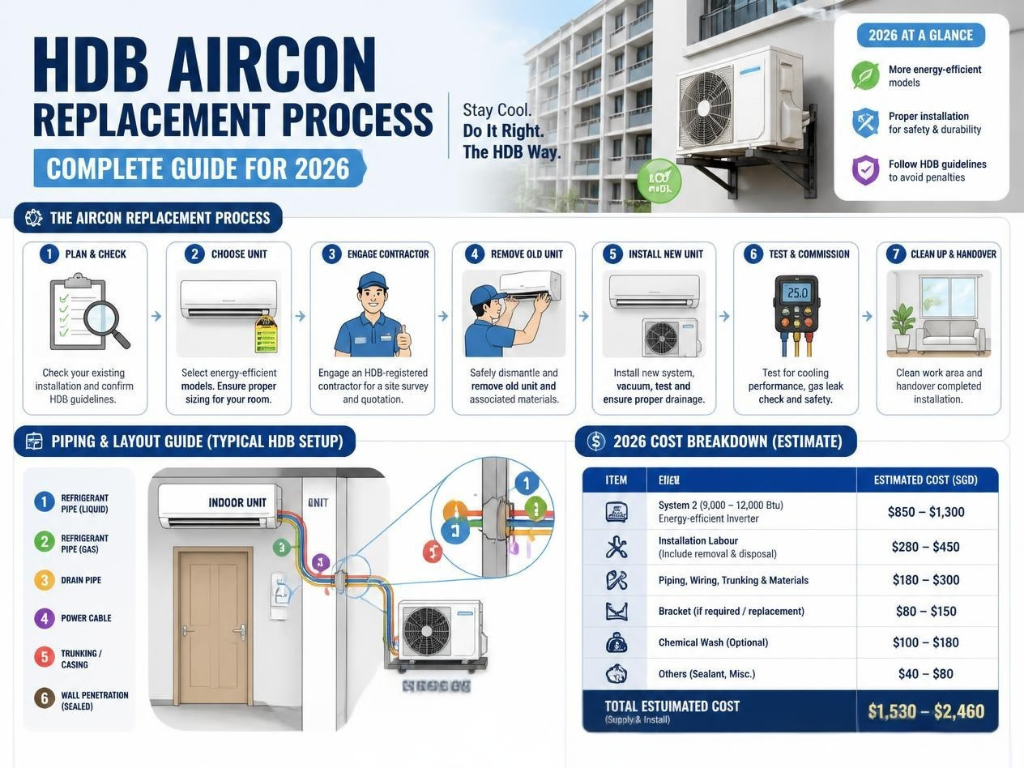
Concealed trunking in newer BTO living rooms: piping is routed through wall-mounted decorative trunking that hides the copper. Replacing this piping requires opening the trunking (usually possible without wall demolition) or reusing the existing piping if refrigerant is compatible. Concealed trunking replacement adds $200 to $500 to the standard replacement cost.
Exposed piping in older HDB flats: copper piping runs visibly along walls, usually insulated with polyethylene foam. Access for inspection, flushing, or replacement is straightforward. Exposed piping replacement adds $100 to $300 depending on run length.
Refrigerant compatibility considerations:
R32 to R32 (both post-2018): usually reusable with nitrogen flush and pressure test. Cost $80-$200 for testing.
R410A to R32 (pre-2018 to new): usually reusable, POE oil compatibility. Cost $80-$200 for testing.
R22 to R32 (pre-2013 flats): NOT reusable. Mandatory replacement due to oil incompatibility and pressure difference. Cost $100-$500+ depending on run length and access.
The chemical wash and overhaul service is an alternative for mid-age units (6-9 years) where cooling weakness is caused by dirt rather than end-of-life aging, potentially delaying replacement need by 3-5 years.
What does HDB aircon replacement cost by flat type?
HDB aircon replacement in 2026 costs by flat type:
- 3-room HDB (typically System 2): $1,400-$1,800 mid-tier inverter, $1,800-$2,200 premium tier
- 4-room HDB (typically System 3): $1,800-$2,400 mid-tier, $2,400-$3,000 premium tier
- 5-room HDB (typically System 4): $2,400-$3,000 mid-tier, $3,000-$3,800 premium tier
- Executive HDB (typically System 4 or dual-System 2): $2,800-$3,500 mid-tier, $3,500-$4,500 premium tier
Base pricing assumptions: mid-tier inverter units (Panasonic, Mitsubishi Electric standard series), standard 3-metre copper piping, HDB-compliant bracket reuse or standard replacement, isolator/MCB compatible with new unit, old unit disposal included.
Common extras for HDB replacement:
- Additional copper piping (beyond 3m): $30-$60 per metre
- Bracket replacement (if legacy non-compliant): $80-$180
- Isolator upgrade (if new unit draws more current): $150-$300 including EMA-licensed electrician
- MCB upgrade (if new unit exceeds existing rating): $100-$250 plus LEW callout
- Concealed trunking work: $200-$500
- R22 refrigerant recovery (for pre-2013 units): $100-$200 premium
- Drainage rerouting to internal floor trap (if legacy external): $150-$250
Total with typical extras usually adds 20-40% above base pricing. Resale flats commonly land at the higher end of this range; BTO flats at the lower end.
The aircon repair and troubleshooting service covers the alternative path when repair may be more economical than replacement for mid-age units.
What noise hours and Town Council rules apply?
HDB aircon replacement must respect the same noise hours that govern renovation work: general work 9am-6pm on weekdays and Saturdays, noisy work (drilling, hammering) 9am-5pm on weekdays only. No noisy work on Sundays or public holidays.
The NEA guidance on noise from renovation work in residential areas codifies these hours. Aircon replacement generates noise at dismantle (drilling to remove old unit brackets), installation (drilling to mount new unit), and refrigerant recovery (pump noise). All three fall within the noise hour restrictions.
Town Council notification varies by estate:
Estates that require notification: some Town Councils ask residents to inform them of scheduled contractor work exceeding 2 hours. Notification is typically via Town Council office or estate app, 1-3 business days ahead.
Estates that don’t require notification: many Town Councils treat aircon replacement as routine appliance work not needing formal notification.
Estate-specific rules can be verified via your Town Council website or by phoning the estate office. When in doubt, notify , it costs nothing and prevents complaints during the work.
The HDB MyNiceHome guidance on aircon maintenance for home owners covers the broader HDB maintenance framework including drainage compliance during aircon work.
Informing immediate neighbours 24-48 hours ahead as a courtesy reduces noise complaints and speeds mediation if a complaint does arise during work.
Conclusion
HDB aircon replacement in Singapore operates under simpler rules than condo but with specific requirements: like-for-like replacement needs no permit, brackets must meet HDB safety specifications, drainage discharges into internal floor traps, and noise hours limit noisy work to 9am-5pm weekdays. Cost ranges $1,400 to $4,500 depending on flat type and whether it’s BTO or resale, with resale flats commonly landing at the higher end due to legacy piping and bracket remediation.
Book an HDB aircon replacement with SACES for a pre-quote inspection that verifies bracket compliance, piping condition by refrigerant type, and electrical infrastructure adequacy before the replacement work is authorised.
FAQs About HDB Aircon Replacement
What system size fits my HDB flat?
3-room HDB typically uses System 2 (1 outdoor + 2 indoor: living + 1 bedroom). 4-room uses System 3 (1 outdoor + 3 indoor: living + 2 bedrooms). 5-room uses System 4 (1 outdoor + 4 indoor: living + 3 bedrooms). Executive uses System 4 or dual-System 2. Living room typically 18,000-24,000 BTU; bedrooms 9,000-12,000 BTU.
How long does HDB aircon replacement take?
HDB aircon replacement takes 4-6 hours for a System 2 or 3 (3-room or 4-room flat) and 6-8 hours for System 4 (5-room or Executive). Includes dismantling old units, installing new units, refrigerant recharge, vacuum test, and cleanup. Same-day completion is standard for most HDB replacements.
Can I upgrade to a larger BTU aircon in HDB?
Yes, upgrading BTU is usually acceptable under like-for-like rule if the new unit fits at the same wall location and electrical supply is adequate. Larger BTU (>20% jump) may trigger isolator or MCB upgrade requiring EMA-licensed electrical worker. Cost for electrical upgrade: $150-$550 including LEW callout.
Do I need HDB permit if I add more aircon units?
Yes. Adding indoor units beyond the original installation is non-like-for-like and requires HDB approval. This is because the additional unit may need a new ledge bracket position (structural consideration) and additional electrical circuits. Application is through HDB Home Improvement Programme or direct HDB engagement depending on the scope.
Should I replace or overhaul my HDB aircon at 8 years?
Overhaul if cooling weakness is caused by dirt or biofilm buildup (verifiable by delta-T test) and compressor is healthy. Replace if compressor is failing or unit uses R22 refrigerant. 8-year unit is in the ambiguous zone: chemical overhaul at $450-$720 for HDB 4-room can extend life 3-5 years and defer the $1,800-$2,400 replacement decision.