
Reuse old aircon copper piping is one of the quietest decisions in a Singapore aircon replacement. R32 to R32 and R410A to R32 usually allow reuse with proper flushing. R22 piping cannot be reused for R32 because of oil chemistry and pressure incompatibility. Age and concealed runs shift the calculation. This blog walks you through when reuse is fine and when it fails, anchored to aircon installation service.
Can I reuse old copper piping when replacing my aircon?
Same-refrigerant replacement (R32 to R32, R410A to R32) usually allows copper piping reuse with proper nitrogen flushing and pressure testing. Cross-refrigerant replacement from R22 does not allow reuse due to oil chemistry, wall thickness, and pipe gauge differences. Age over 10 years, visible damage, and concealed runs with no inspection access are separate hard-stops on reuse regardless of refrigerant type.
Reuse decision depends on four factors:
Refrigerant compatibility: R32 and R410A both use polyol ester (POE) oil and similar operating pressures. R22 uses mineral oil at lower pressure with thinner-walled pipes.
Pipe age and condition: pipes over 10 years old often have internal corrosion or micro-cracks that only pressure test reveals. Visible external damage (kinks, dents, corrosion, insulation failure) rules out reuse.
Pipe gauge: R32 and R410A residential systems use the same copper gauges (1/4″ liquid line + 3/8″ or 1/2″ gas line typical). R22 systems used similar sizing but thinner wall thickness.
Access: exposed piping can be inspected and flushed. Concealed piping in walls (common in Singapore condo installations) can’t be verified without opening the wall.
Reuse saves $100 to $300 typically on standard 3-6 metre runs but adds $80 to $200 flushing and pressure test costs. Net saving is modest; risk shifts if the reuse fails after installation.
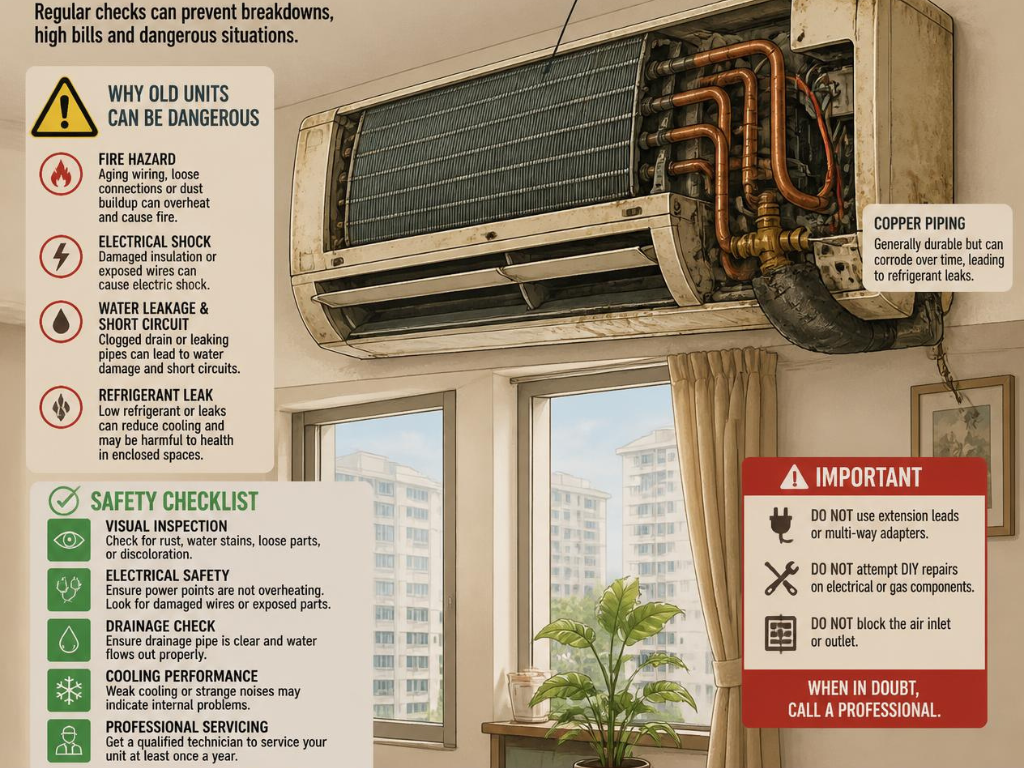
When is copper piping reuse safe?
Copper piping reuse is safe when all five conditions are met: same-refrigerant replacement, pipe under 10 years old, no visible damage, exposed or accessible piping run, and completed nitrogen flush plus pressure test.
Specifically:
R32 to R32 replacement, unit under 8 years old, accessible piping: reuse is standard practice. Nitrogen flush recommended but not always required.
R410A to R32 replacement, unit under 8 years old, accessible piping: reuse is common. POE oil compatibility means residue doesn’t contaminate. Flush and pressure test both recommended.
R32 to R32 replacement, 8-10 years old: reuse acceptable with mandatory flush and pressure test. Contractor should document test results.
Any refrigerant migration involving R22: reuse not acceptable regardless of pipe age.
Exposed piping runs where the technician can visually inspect every metre pass reuse cleanly. If any single point can’t be inspected (behind trunking, inside wall cavity), the entire run should be treated as concealed with different risk calculus.
Reuse assessment should be part of the pre-quote inspection so the flush-versus-replace decision runs on actual condition rather than assumptions.

When does copper piping reuse fail and require replacement?
Copper piping reuse fails in six scenarios: R22 migration, pipe over 10 years old, visible damage, concealed run without inspection access, previous refrigerant leak history, and failed pressure test.
R22 migration: mineral oil residue contaminates R32/R410A systems, shortens compressor life significantly, and may void manufacturer warranty. Also, R22 pipes are thinner-walled for lower operating pressure and can rupture under R32’s higher pressure. Mandatory replacement.
Pipe over 10 years: internal micro-cracks accumulate. Not always visible externally. Pressure test may pass initially but fail within 12-24 months, causing refrigerant loss and secondary compressor damage.
Visible damage: kinks, dents, insulation failure exposing bare copper, green oxidation, or crush damage rules out reuse. Kinks reduce internal diameter and restrict refrigerant flow, stressing compressor.
Concealed run with no access: Singapore condo installations often route piping through walls or ceiling trunking. Without opening the wall, the pipe interior can’t be inspected. Reuse becomes a gamble.
Previous refrigerant leak: if the old system leaked at any point in the last 3 years, the leak location often can’t be identified in old piping. New refrigerant will leak at the same point.
Failed pressure test: nitrogen at 300-500 psi, 24-hour hold, pressure drop exceeding 20 psi indicates a leak somewhere. Reuse impossible without repair. The professional aircon inspection service covers pre-quote piping assessment for units where reuse condition is uncertain.
Why can’t R22 piping be reused for R32 aircon?
R22 piping cannot be reused for R32 for three reasons: oil chemistry incompatibility, wall thickness inadequacy for R32 operating pressure, and pipe gauge differences on some system sizes.
Oil chemistry: R22 systems use mineral oil to lubricate the compressor. This oil coats the interior of the copper piping. R32 systems use polyol ester (POE) oil. When R32 refrigerant flows through pipes coated with mineral oil residue, the two oils don’t mix (like water and oil). Mineral oil eventually reaches the R32 compressor and causes accelerated wear.
Wall thickness: R22 operates at lower pressures (around 200-250 psi discharge) than R32 (around 400-450 psi discharge). R22 copper piping is often manufactured with thinner walls that meet R22 pressure ratings but not R32. Using R22 piping for R32 risks pipe splitting or joint failure under higher operating pressure.
Pipe gauge: some system sizes changed pipe gauge between R22 and modern refrigerants. Older 7 kW R22 systems used 5/8″ x 1/4″ gauges; modern R32 equivalents may use 1/2″ x 1/4″. Wrong gauge affects capacity and efficiency.
Flushing alone doesn’t solve any of these. The mineral oil residue is embedded in the copper’s inner surface and cannot be fully removed by flushing. Wall thickness cannot be modified. Gauge cannot be changed.
For R22 units being replaced, the aircon gas top-up service can address minor R22 leaks in the short term, but replacement (including piping) is the correct long-term path. The UNEP Ozone Secretariat sustainable cooling policy toolkit covers the Kigali Amendment framework driving R22 phase-down.
What is nitrogen flushing and does it work?
Nitrogen flushing (oxygen-free nitrogen, or OFN) is the industry-standard procedure for cleaning copper refrigerant piping between refrigerant charges. The technician purges nitrogen at 150-300 psi through the piping to blow out residual oil, moisture, and particulates.
Standard flushing procedure:
Disconnect old unit, recover refrigerant, remove indoor and outdoor units. Piping remains in place.
Connect nitrogen cylinder via manifold to one end of the pipe. Blow nitrogen through at 150-300 psi from the outdoor end to the indoor end. Continue until nitrogen flow stops carrying oil residue (visual check at outlet).
Repeat flush in reverse direction. Some contractors do a solvent flush intermediate step for POE-to-POE reuse where micro-contaminants are suspected.
Vacuum-dry to 500 microns Hg to remove any remaining moisture.
Connect new unit. Pressure test at 300-500 psi for 24 hours before charging refrigerant.
Cost: $80 to $200 for professional flush including nitrogen, labour, and pressure test. The aircon pressure test service covers standalone testing.
Flushing works for POE-to-POE reuse (R32 to R32, R410A to R32). It does NOT reliably remove mineral oil from R22-contaminated piping. The Daikin R32 split series installation manual documents the OFN purging protocol in detail as the manufacturer-specified standard for R32 piping preparation and brazing operations.
Flushing has limits. It cannot fix physical damage, cannot detect internal micro-cracks, and cannot restore wall thickness. Reuse assessment must combine flushing with visual inspection and pressure testing.
How much does replacement vs flushing cost?
Replacing copper piping costs $30 to $60 per metre in Singapore in 2026, typically $100 to $300 total for standard 3-6 metre runs. Flushing and pressure testing costs $80 to $200 total. On the surface, flushing appears cheaper.
Realistic cost comparison for standard 3-6 metre run:
- Flushing and testing: $80 to $200 (flush + pressure test)
- Replacement of exposed piping: $100 to $300 (materials + labour)
- Replacement of concealed piping: $250 to $500+ (materials + labour + wall opening + patching)
For exposed accessible piping, flushing is cheaper by $20 to $200. Real saving.
For concealed piping, flushing is much cheaper because replacement requires opening walls. This is why most Singapore condo installations opt for flushing on concealed runs even when replacement would be technically safer.
Hidden costs of failed reuse: refrigerant loss ($80 to $200 for top-up if leak develops), compressor damage ($500 to $900 if mineral oil residue causes wear over 2-3 years), warranty complications (some manufacturer warranties are void if piping wasn’t verified clean).
Cost tips over 5-10 year unit lifetime: on exposed piping, spending $200 on new pipe often outperforms $100 on flushing given failure downside. On concealed piping, spending $200 on flushing plus pressure test is usually the pragmatic choice.
The general aircon replacement guidance covers the broader cost picture beyond just the piping decision.
Do R32 and R410A use the same copper pipe sizes?
Yes, R32 and R410A use the same standard copper pipe gauges for residential aircon systems: 1/4″ (6.35mm) liquid line and 3/8″ (9.52mm) or 1/2″ (12.7mm) gas line depending on cooling capacity.
Typical residential system pipe sizing:
- 9,000-12,000 BTU (small bedroom): 1/4″ liquid + 3/8″ gas
- 18,000-24,000 BTU (living room): 1/4″ liquid + 1/2″ gas
- 30,000+ BTU (large living or multi-split): 1/4″ liquid + 5/8″ gas
Wall thickness: R32 and R410A both require minimum 0.8mm wall thickness for standard residential pipe runs under 15 metres. Longer runs or larger capacity systems may require thicker walls.
Insulation: R32 and R410A both require polyethylene foam insulation, minimum 10mm thickness for standard piping. Singapore’s high ambient humidity (80%+ year-round) means 20mm insulation is often used to prevent condensation.
For R410A to R32 replacement, no gauge or wall thickness change is needed on the piping itself. This is the technical basis for why R410A piping is generally reusable for R32 with flushing.
R22 piping often used the same nominal sizes (1/4″, 3/8″, 1/2″) but with thinner wall thickness rated for lower pressure. Even if the gauge appears identical, the wall thickness inadequacy makes R22 pipe unsuitable for R32.
How is the reused piping pressure tested?
Pressure test after piping reuse uses nitrogen at 300-500 psi held for 24 hours with pressure drop monitored. A drop of less than 5 psi over 24 hours confirms leak-free integrity. Drops of 20+ psi indicate a leak requiring investigation.
Standard procedure:
Vacuum the system after flushing to 500 microns Hg to verify dryness.
Charge nitrogen through the service port to 300-500 psi. Close valves.
Record initial pressure and ambient temperature.
Wait 24 hours (48 hours for slow leak suspicion).
Record final pressure. Adjust for ambient temperature changes (about ±5 psi per 10°C swing).
Interpret: below 5 psi drop = pass; 5-20 psi drop = ambient variation or minor concern; above 20 psi drop = leak.
If a leak is found, soap solution or electronic leak detector wand locates the specific joint or pipe section. Repair, retest, and verify before proceeding to refrigerant charge.
Skipping the post-reuse pressure test is common contractor corner-cutting. Without it, a slow leak develops undetected, causing refrigerant loss and compressor damage within 6-12 months. Ask the contractor to include written pressure test results as part of the installation deliverables.
Conclusion
Reusing old aircon copper piping in Singapore is fine for same-refrigerant replacement (R32 to R32, R410A to R32) on units under 8 years old with accessible piping runs after proper nitrogen flushing and pressure testing. It fails on R22 migrations, pipe over 10 years old, visible damage, concealed runs without inspection access, or failed pressure tests. Flushing saves $20 to $200 on exposed runs and much more on concealed runs, but only when reuse conditions are actually met.
Book an aircon installation with SACES for a piping reuse assessment as part of the pre-quote inspection, so the flush-versus-replace decision runs on the actual condition of your specific system rather than assumptions.
FAQs About Reuse Old Aircon Copper Piping
Can I reuse R410A piping for R32 aircon?
Yes, R410A copper piping can be reused for R32 in most Singapore residential installations. Both refrigerants use polyol ester (POE) oil and operate at similar pressures (400-450 psi discharge). Standard nitrogen flush plus 24-hour pressure test at 300-500 psi confirms integrity before installing the new R32 unit. Cost: $80 to $200 for professional flush and test.
Can old copper piping cause new aircon to leak?
Yes. Old piping with internal micro-cracks, damaged flare joints, or corrosion causes refrigerant leaks in new aircon systems within 6-24 months of installation. Pressure test at 300-500 psi held 24 hours identifies leaks before charging refrigerant. Skipping this test is the most common cause of premature leak failure on units with reused piping.
How long should copper aircon piping last in Singapore?
Copper aircon piping in Singapore lasts 10-15 years with proper insulation and installation. Coastal or industrial-adjacent installations degrade faster (8-12 years) due to accelerated external corrosion. Concealed piping in walls with good insulation can last 15-20 years. Age itself doesn’t disqualify reuse; condition and pressure test results do.
What does nitrogen flushing cost in Singapore?
Nitrogen flushing costs $80 to $200 in Singapore in 2026 depending on pipe run length and complexity. Standard 3-6 metre residential run runs $100 to $150. Cost usually includes oxygen-free nitrogen (OFN), technician labour, vacuum pump for drying, and 24-hour pressure test. Standalone pressure test without flush runs $80 to $180.
Should I open the walls to inspect concealed piping?
Only if there’s specific reason to suspect damage (previous leak history, unusual cooling loss patterns, water damage in adjacent area). Wall opening adds $200 to $500 for opening plus patching. For most concealed piping under 10 years old with no leak history, nitrogen flushing and pressure test provide sufficient reuse validation without wall opening.