
Replace or repair aircon is the decision most Singapore homeowners face around the 8-10 year mark. The 40% rule says: if the repair cost exceeds 40% of replacement cost, replace instead. But age, refrigerant type, warranty status, and recurring breakdown pattern all shift the threshold. This blog walks you through the cost and age thresholds that decide it, anchored to aircon installation and replacement in Singapore.
Should I replace or repair my aircon in Singapore?
Replace if the unit is 10+ years old, uses R22 refrigerant, has had 3+ major repairs in the past 24 months, or if the pending repair costs more than 40% of a new unit. Repair if the unit is under 8 years old, the fault is a single accessible component, and the total repair cost stays under 30% of replacement.
The decision integrates four factors: age, cost ratio, refrigerant type, and breakdown frequency. Any single factor pushing hard toward replacement can override the others. A 6-year-old unit with 2 breakdowns in 3 months signals systemic wear regardless of repair cost. A 12-year-old R22 unit with a compressor failure should replace even if the repair quote sounds reasonable in isolation.
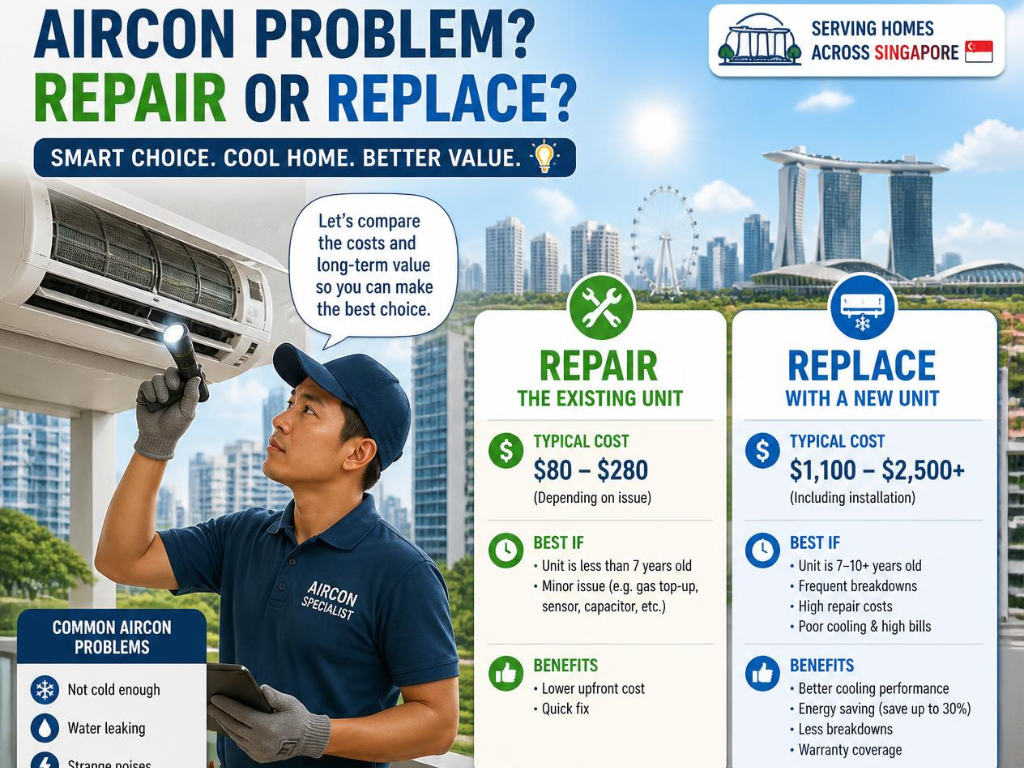
Typical Singapore residential replacement costs $700 to $2,800 base by system type. Repair costs range from $80 for a fan motor to $500-$900 for compressor replacement, plus refrigerant recharge and labour. The general aircon replacement guidance covers pricing detail; the aircon repair and troubleshooting service covers repair scoping.
The framework doesn’t apply to warranty situations. Manufacturer warranty repair is nearly always the right choice regardless of the 40% rule.
What’s the 40% rule and how does it apply in Singapore?
The 40% rule says: if the total cost to repair equals or exceeds 40% of replacing the unit, replace instead. This is an industry heuristic based on the assumption that repair extends life 2-5 years while replacement extends it 10-15 years.
Concrete Singapore application:
Single split (9,000-12,000 BTU) replacement runs $700 to $1,400. 40% threshold: $280 to $560. If your repair quote crosses $560 on a single split, replace becomes the cleaner economic choice.
System 3 replacement runs $1,800 to $2,400 for mid-tier inverter. 40% threshold: $720 to $960. Repair over $960 on a System 3 pushes toward replacement.
System 4 replacement runs $2,400 to $3,000. 40% threshold: $960 to $1,200. Repair over $1,200 favours replacement.
The rule assumes the repair actually resolves the underlying issue. A $400 fan motor replacement on a unit whose compressor is 3 months from failure is not a repair; it’s postponement. Age-adjust the threshold downward: 8+ year old unit, use 30% instead of 40%.
Regional variants of this rule exist. Some HVAC industries use 50%. US HVAC contractors use the “5000 rule” (multiply age × repair cost; if the result exceeds 5000, replace). The 40% rule is the more common Singapore residential heuristic.
At what age should I stop repairing and replace?
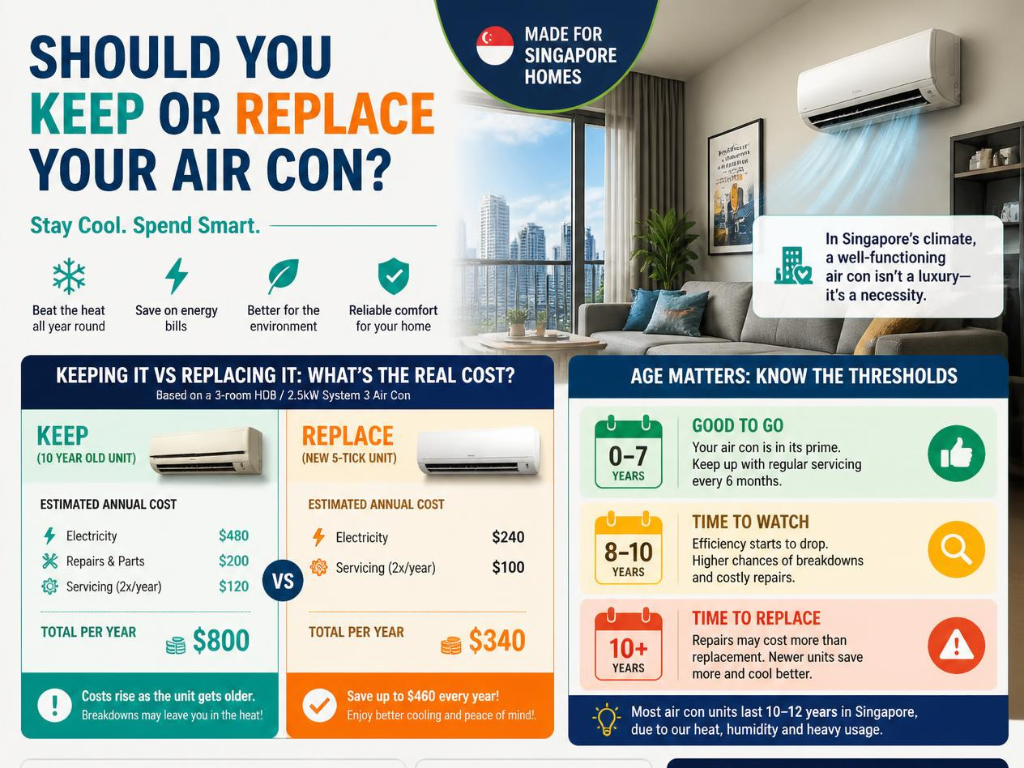
10 years is the industry rule of thumb for Singapore residential aircon replacement. Systems 12+ years old should replace on any major repair. Systems 5-8 years old should repair unless multiple factors align against.
Age brackets and decision defaults:
0-3 years: repair. Almost certainly still under warranty. Warranty repair should always win over out-of-pocket replacement.
4-7 years: repair typically. Unit is mid-life. Repair unless cost exceeds 40% of replacement.
8-10 years: judgment call. Apply the 40% rule strictly, factor in breakdown history, check refrigerant type.
11-12 years: replace default. Any major component failure (compressor, evaporator coil, condenser coil) pushes replacement.
13+ years: replace regardless. Cumulative wear approaches end-of-life. Continued repair is throwing good money after bad.
Singapore climate ages units faster than temperate countries. Aircons here run 2,000 to 4,000 operating hours per year compared to 800 to 1,200 in seasonal climates. A 10-year-old Singapore unit has experienced usage equivalent to 20-25 years in a temperate country. Adjust expectations accordingly.
Well-maintained units with quarterly servicing and annual chemical wash can reach 15 years. Poorly maintained units fail at 6-8. Maintenance history matters more than calendar age.
Is compressor failure worth repairing?
Compressor failure on a unit older than 8 years is rarely worth repairing. Compressor replacement costs $500 to $900 in Singapore in 2026, plus $150 to $300 in refrigerant recharge and labour, totalling $650 to $1,200. That’s often 50-70% of replacement cost.
The compressor is the most expensive single component and the one most affected by cumulative wear. When a compressor fails, other components (capacitor, control board, evaporator coil) are usually also aging. Replacing the compressor extends life 2-3 years typically; the other components will fail in that window.
Compressor failure on a unit under 5 years old: repair, ideally under warranty. Manufacturer compressor warranty is typically 5 years on major brands (Daikin, Mitsubishi Electric, Panasonic).
Compressor failure at 5-8 years: judgment call. If warranty still applies, repair. If out-of-warranty and repair cost exceeds 40% of replacement, replace.
Compressor failure at 8+ years: replace. Age plus major-component failure signals whole-system end-of-life.
There’s one exception: if the unit is 5-8 years old with a compressor failure that’s clearly caused by an external factor (voltage surge, water damage), the compressor may be an isolated issue. Repair is defensible in this scenario.
When do recurring breakdowns force replacement?
3 or more major breakdowns within 24 months signals systemic aging and pushes toward replacement regardless of individual repair costs.
Minor issues (dirty filter, drain clog, thermostat fault) don’t count. Major issues (refrigerant leak, compressor issue, control board failure, fan motor replacement) do count.
Cumulative repair spend is the harder metric. If you’re spending $400+ per year on a unit for 2-3 consecutive years, total spend approaches replacement cost without extending life proportionally. Common thresholds:
- $400 to $600 cumulative in 24 months on unit older than 8 years: replace
- $600 to $900 cumulative in 24 months on unit older than 6 years: replace
- $900+ cumulative regardless of age: replace unless warranty situation
Recurring breakdowns also cause hidden costs: downtime during Singapore heat, discomfort during breakdowns, and potential secondary damage (water damage from failed drain, electrical damage from failed capacitors). These aren’t in the repair quote but are real costs.
Sometimes 2 breakdowns on a 6-year-old unit trace to skipped servicing rather than aging. A diagnostic visit can distinguish between fixable maintenance neglect and genuine end-of-life aging before you commit to replacement.
What if my aircon still uses R22 refrigerant?
R22 units should replace on any major repair regardless of age, cost, or breakdown history. R22 phase-out under the Montreal Protocol has made maintenance economically painful and getting worse.
R22 refrigerant supply is dwindling. Global production ended in 2020. Existing stockpile is being depleted through servicing. Singapore R22 top-up in 2026 runs $150 to $280 per residential unit versus $80 to $150 for R32. The UNEP Ozone Secretariat sustainable cooling policy toolkit covers the international phase-down framework driving supply reduction.
Over 3-5 years, ongoing R22 maintenance approaches or exceeds replacement cost. Example: 2 R22 top-ups per year at $200 each equals $400/year, or $2,000 over 5 years. Plus any repairs. Replacement to R32 at $1,500 delivers better economics within 3-4 years.
R22 units are typically 12+ years old in Singapore (2013 was the last common installation year for R22 residential). The age itself often pushes replacement independently. Combined with R22 economics, replacement is nearly always the right call.
Do not accept a repair quote on an R22 unit without asking the contractor: how much longer will R22 refrigerant be available at reasonable prices? A vague answer means the contractor is deferring the phase-out reality onto you.
For R22 owners with mid-age units (8-11 years, unusual but exists), the aircon gas top-up service can extend life 2-3 years if the leak is minor. Beyond that, replacement is the clean path.
What’s the energy efficiency gain from replacing?
Replacing an 8-10 year old aircon with a new 5-tick inverter unit reduces electricity consumption 30-40% for the same cooling output. On a typical Singapore residential aircon running 8-10 hours daily, that translates to $170 to $350 per year in electricity savings per unit.
The NCCS coverage of revised energy labels for air-conditioners explains the Mandatory Energy Labelling Scheme (MELS) tick rating system. 5-tick units use significantly less electricity than 2-3 tick units of the same capacity.
Compounded savings example for System 3 replacement:
Old System 3 (10 years, likely 2-3 tick R410A): about $2,000 to $2,400 per year electricity. New 5-tick R32 System 3: about $1,200 to $1,400 per year electricity. Annual savings: $800 to $1,000 per year. Over 10-year lifespan: $8,000 to $10,000 in electricity savings.
Efficiency gain isn’t just from tick rating. Older units have degraded refrigerant charge, dirtier coils (even after cleaning), and aged compressors that run at reduced efficiency. Combined age-related degradation of 15-25% plus tick rating improvement can push replacement gain toward 40-50% consumption reduction.
For low-usage installations (below 3 hours daily), the electricity savings don’t justify replacement on efficiency grounds alone. Combine with age, repair, or refrigerant factors.
Can a chemical overhaul be the third option instead?
Chemical overhaul is genuinely the third option for mid-age units (6-9 years) where the underlying issue is dirt, biofilm, or coil fouling rather than end-of-life aging.
Chemical overhaul costs $150 to $280 per fan coil in Singapore in 2026. For a full HDB 4-room package, $450 to $720. This is 20-40% of replacement cost but extends life 3-5 years when applied to units suffering from cleanable issues rather than aging components.
When chemical overhaul is the right call:
- Unit is 6-9 years old (mid-age)
- Cooling weakness caused by dirty coil (verifiable by delta-T test)
- Compressor and major components healthy
- Refrigerant charge normal, no leak
- Odour or biofilm issue driving the decision
When chemical overhaul is NOT the fix:
- Compressor showing symptoms of failure
- Unit is 11+ years old
- Recurring breakdown pattern beyond dirt-related issues
- R22 unit facing phase-out economics
The chemical wash and overhaul service covers when overhaul is genuinely the right option versus a stopgap.
For units in the ambiguous 6-9 year age with mild symptoms, chemical overhaul followed by 90-day monitoring is a reasonable trial. If cooling doesn’t restore or new issues emerge in 90 days, escalate to replacement decision.
What if my aircon is still under warranty?
Under-warranty repair is always the right choice regardless of the 40% rule or age brackets. Warranty repair is manufacturer-funded; out-of-pocket replacement is homeowner-funded. The economics favour warranty repair even if the underlying unit is aging.
Standard warranty structure for Singapore residential aircons:
- Installation warranty: 1 year (contractor-specific, covers workmanship)
- Compressor warranty: 5 years (manufacturer)
- Parts warranty: 1-2 years (manufacturer)
Post-warranty economics differ significantly. A compressor failure at year 4 (still under warranty) means free repair. The same failure at year 6 means $650 to $1,200 out-of-pocket. This is why manufacturer warranty period is a natural inflection point for the repair vs replace decision.
Extended warranty programmes offered by retailers can shift the calculation. If you paid for 5-year extended warranty at time of purchase, use it during years 3-5 aggressively. If the failure happens month 60 of a 60-month warranty, claim first, then evaluate replacement.
The professional aircon inspection service can document warranty-relevant conditions for insurance or manufacturer claim purposes.
Conclusion
Replace or repair aircon in Singapore comes down to age (10 years is the pivot), cost ratio (40% rule, tightening to 30% at 8+ years), refrigerant type (R22 forces replacement), warranty status (under warranty equals repair), and breakdown history (3+ major issues in 24 months equals replace). Chemical overhaul is the third option for mid-age units with cleanable issues. Compressor failure on units older than 8 years nearly always favours replacement.
Book an aircon inspection with SACES for a specific unit assessment. The visit produces a written recommendation on repair scope, replacement scope, or overhaul scope with cost estimates for each path so the decision runs on your specific numbers, not general rules.
FAQs About Replace Or Repair Aircon
What’s the 40% rule for aircon repair vs replace?
The 40% rule states: if repair cost equals or exceeds 40% of replacement cost, replace instead. On a $2,000 replacement, that’s the $800 threshold. The rule assumes repair extends life 2-5 years while replacement extends 10-15 years. Adjust the threshold downward to 30% for units 8+ years old to account for accumulated wear.
Is it worth repairing a 10-year-old aircon?
Rarely, for major repairs. 10-year-old Singapore aircons have accumulated the equivalent of 20-25 years of usage in temperate climates due to continuous operation. Compressor or coil failure at 10 years should replace. Minor issues (fan motor, capacitor, drain pump) under $200 can repair for another 1-2 years of service before the replacement decision returns.
How much does it cost to replace an aircon compressor in Singapore?
Compressor replacement in Singapore in 2026 costs $500 to $900 for the part, plus $150 to $300 for refrigerant recharge and labour, totalling $650 to $1,200. This is 50-70% of replacement cost on a single-split unit, which is why compressor failure on units older than 8 years typically pushes toward replacement instead of repair.
Should I replace my aircon because of R22 phase-out?
Yes, if the unit needs any major repair. R22 refrigerant is on Montreal Protocol phase-down and Singapore top-up costs $150 to $280 versus R32’s $80 to $150. Continued R22 maintenance approaches replacement cost within 3-5 years. Even if the unit is functional, an R22 system nearing end-of-life should be budgeted for replacement.
Does chemical overhaul really extend aircon life?
Yes, for 6-9 year old units with dirt or biofilm issues rather than aging components. Chemical overhaul at $150 to $720 depending on package can extend life 3-5 years by removing coil fouling that stresses the compressor. Not a substitute for replacement on units with actual component failure or 11+ years of age.