
Aircon replacement cost Singapore quotes range from $700 to $2,800 by system type, but the final invoice can add 20-40% in extras. Copper pipe re-run, bracket replacement, isolator upgrade, and R22 refrigerant handling are the quiet inflaters. This blog walks you through base pricing by system type and the extras that show up in real quotes, anchored to aircon installation and replacement service.
How much does aircon replacement cost in Singapore in 2026?
Aircon replacement in Singapore in 2026 costs $700 to $2,800 for a full system installation, with variance driven by system type (number of indoor units), brand tier, inverter versus non-inverter, and installation extras. Base pricing on major brand mid-tier inverter units: $700-$1,400 single split, $1,400-$1,800 System 2, $1,800-$2,400 System 3, $2,400-$3,000 System 4, $3,000-$3,800 System 5.
Base pricing typically covers the new fan coil and condenser, one refrigerant charge, standard copper piping run of up to 3 metres, one wall bracket, standard drainage rerouting, and old unit removal. Every extra beyond this scope is quoted as additional line items.
The typical extras that inflate a base quote: additional copper piping length ($30 to $60 per metre), non-standard bracket ($80 to $180), isolator upgrade ($150 to $300), MCB upgrade ($100 to $250 including LEW callout), R22 refrigerant recovery ($100 to $200 premium), and old unit disposal fee ($30 to $80).
Complete package including realistic extras usually falls 20-40% above headline base price. HDB 4-room System 3 replacement typically lands $2,100 to $2,800 all-in.
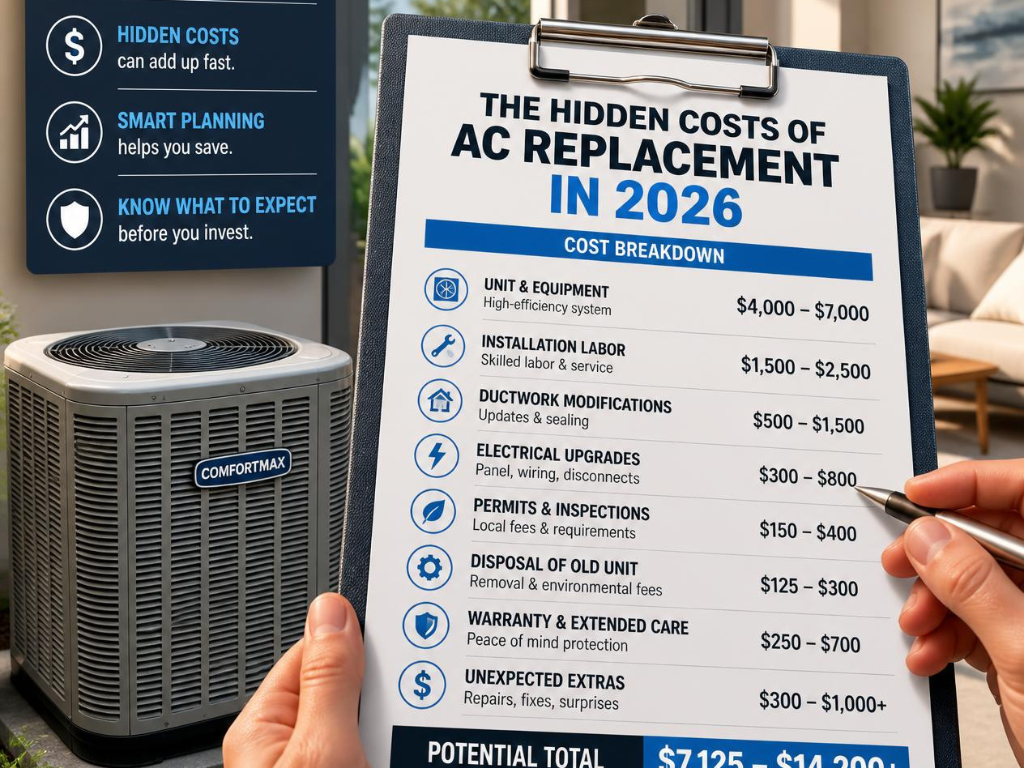
What’s the cost by system type: System 1 through System 5?
Singapore aircon system types correspond to the number of indoor units connected to one outdoor condenser. Cost scales with system size.
System 1 (single split): 1 outdoor + 1 indoor. Typical use: single-room installation, small studio. 2026 cost: $700 to $1,400 depending on brand and BTU.
System 2 (2 indoor units + 1 outdoor): typical for 3-room HDB or small condo studio. 2026 cost: $1,400 to $1,800 mid-tier inverter, $1,800 to $2,200 premium tier.
System 3 (3 indoor units + 1 outdoor): most common for HDB 4-room and standard condo. 2026 cost: $1,800 to $2,400 mid-tier, $2,400 to $3,000 premium tier. This is the workhorse system in Singapore residential.
System 4 (4 indoor units + 1 outdoor): typical for HDB 5-room, larger condos, executive apartments. 2026 cost: $2,400 to $3,000 mid-tier, $3,000 to $3,800 premium tier.
System 5 (5 indoor units + 1 outdoor): landed properties, large penthouses. 2026 cost: $3,000 to $3,800 mid-tier, up to $5,000 for full inverter multi-split with premium brand.
Brand tiers: Mid-tier includes Panasonic and Mitsubishi Electric standard series. Premium tier includes Daikin premium series and Mitsubishi high-end. Budget tier (Midea, older Toshiba) undercuts by 10-20% but has shorter warranty and thinner spare parts availability.
For commercial and small office contexts, the small office aircon installation covers B2B pricing considerations. For broader replacement guidance, the general aircon replacement guidance covers the decision-making before quote request.
What extras quietly inflate the replacement quote?
Six extras appear in most Singapore aircon replacement invoices but rarely in headline pricing. Understanding what they cost prevents surprise on the final invoice.
Copper pipe re-run beyond 3 metres. Standard installation includes 3 metres of copper piping between indoor and outdoor unit. Beyond that, additional pipe runs $30 to $60 per metre. Older HDB units with long runs to service ledge often need 5-8 metres. Extra cost: $60 to $300.
Bracket replacement. If the existing outdoor bracket is corroded, non-HDB-approved, or wrong size for the new unit, replacement is required. $80 to $180 per bracket. Especially common on pre-2010 HDB units where legacy brackets don’t meet current standards.
Isolator switch upgrade. The wall-mounted isolator (safety disconnect near unit) may need upgrading if the new unit draws more current than the old one. This is common when going from smaller BTU to larger BTU, or from single to multi-split. $150 to $300 for isolator including certified electrician callout.
MCB and DB box work. If the new unit exceeds the existing MCB rating (typically 10A or 16A on older HDB), an MCB upgrade is required. This work needs an EMA-licensed electrical worker. $100 to $250 including LEW callout. Some replacements trigger a full DB box scope check.
R22 refrigerant handling. If the old unit uses R22, refrigerant recovery must be performed by a certified handler under NEA rules. Old refrigerant cannot be vented. Premium: $100 to $200 above standard replacement cost.
Old unit disposal. Under Singapore’s Extended Producer Responsibility scheme, old aircons are e-waste and must be collected by an approved recycler. Some retailers include disposal in the quote; many charge separately at $30 to $80 per unit.
Add all six to a base quote and the actual out-of-pocket can climb 20-40%. A $2,000 base quote often lands $2,400 to $2,800 all-in with extras.
Do I need new copper piping and bracket?
Not always, but the answer depends on the age and condition of the existing copper piping and outdoor bracket. Reusing both saves $100 to $500; replacing both is often mandatory for R22-to-R32 migrations.
Copper piping reuse: same-refrigerant replacement (R32 to R32) allows piping reuse if it’s clean, correctly gauged, and undamaged. Cross-refrigerant replacement (R22 to R32) usually requires new piping because R22 systems used different lubricants that contaminate R32-compatible systems.
Piping condition matters. Copper piping that has been in service 8+ years often has internal corrosion or slight leaks that only pressure test reveals. If the pressure test fails on old piping, replacement is unavoidable.
Bracket reuse: reusable if the bracket is HDB-approved, correctly sized for the new outdoor unit weight, and structurally sound. Reject reuse if the bracket shows corrosion, was installed pre-2010 without HDB-compliant specifications, or the new outdoor unit is heavier than the old (more than 20% weight increase).
For older HDB flats, both piping and bracket replacement is common. Budget $200 to $500 above headline installation cost for these two items on pre-2010 units.
The professional aircon inspection service is worth booking before requesting quotes if you want to know which extras your specific unit will trigger.
Does replacement trigger an isolator or MCB upgrade?
Sometimes. Isolator or MCB upgrade is triggered when the new aircon draws more current than the old, when the old wiring shows age-related damage, or when the existing components don’t meet current safety standards.
Isolator switch: the wall-mounted disconnect near each aircon. Older isolators sized for smaller BTU units may need upgrading if the new unit is larger. Upgrade cost: $150 to $300 including EMA-licensed electrician callout.
MCB (Miniature Circuit Breaker) in the DB box: sized to the maximum current draw of the appliance. A 10A MCB serving a 9,000 BTU R410A unit is undersized for a 12,000 BTU R32 replacement drawing higher startup current. Upgrade: $100 to $250 plus LEW callout.
Full DB box scope check: if your DB was installed pre-2000 and the aircon replacement is one of several appliance changes, a broader DB box safety check may be prudent. This is a separate quote from the aircon contractor.
Any work on the DB box requires an EMA-licensed electrical worker. Aircon contractors without electrical licensing cannot legally touch the DB. SACES covers both aircon and electrical scopes, so isolator or MCB work happens without a second contractor visit.
What’s the R22 legacy premium on replacement?
R22 aircon replacement costs $150 to $400 more than R32-to-R32 replacement because of refrigerant handling, disposal, and system contamination considerations.
R22 refrigerant recovery: mandatory under NEA rules. Old refrigerant cannot be vented; certified handler recovers it into approved cylinder for licensed disposal. Adds $100 to $200 to labour cost. The aircon gas top-up service covers refrigerant handling context for R22 systems still in service.
Copper piping replacement: R22 systems use mineral oil in the compressor; R32 systems use POE ester oil. Mineral oil residue in old copper piping contaminates R32 systems and shortens compressor life. Piping replacement usually mandatory. Adds $100 to $250 for standard 3-6 metre run.
Isolator and MCB check: R32 units may draw slightly higher startup current than the R22 equivalent, triggering electrical upgrade needs.
For R22 owners considering replacement: this is the right time. R22 refrigerant supply is dwindling under Montreal Protocol phase-down, and continued top-ups on R22 units cost $150 to $280 per top-up (versus $80 to $150 for R32). Over 3-5 years, the cost of maintaining an R22 system approaches the cost of replacement.
Do not accept a quote to refill R22 and skip replacement if the unit is 12+ years old. This is a short-term saving that becomes a longer-term cost.
How is my old aircon disposed of and who pays?
Old aircon disposal in Singapore is regulated under the NEA Extended Producer Responsibility (EPR) System for E-waste Management. Aircons are regulated products; producers and importers are responsible for end-of-life collection.
Under EPR, most retailers and installers offer takeback when delivering a new aircon. The takeback is typically bundled into the replacement service at no additional charge, but some contractors itemise it at $30 to $80 per unit. Ask upfront whether disposal is included.
The Alba Group operates the licensed Producer Responsibility Scheme for regulated e-waste in Singapore, running from July 2021 to June 2026 under the current tender. Aircons collected under the scheme go to licensed recyclers for material recovery (copper, aluminum, plastic separation) and refrigerant handling.
Alternative disposal routes: DIY drop-off at NEA e-waste bins is not suitable for aircons (too large for the bins). Town councils organise quarterly bulk e-waste collection drives which accept aircons. Or engage the licensed recycler directly.
Refrigerant recovery is separate from unit disposal. Even if the physical unit is taken away, the refrigerant inside must be recovered by a certified handler before disposal. This is included in the standard replacement quote and doesn’t require homeowner action.
Inverter or non-inverter: which is cheaper long term?
Inverter is cheaper long term for typical Singapore residential use, despite $200 to $400 higher upfront cost per unit. Payback period is 3-4 years of standard operation, with net savings continuing over the remaining unit lifespan.
Inverter compressors adjust motor speed continuously rather than cycling on/off. Under standard Singapore usage (8-12 hours daily), inverter units consume 30-40% less electricity than non-inverter for the same cooling output. Singapore’s Mandatory Energy Labelling Scheme (MELS) rates aircon efficiency on a 1-5 tick scale. The NCCS coverage of revised energy labels for air-conditioners explains the CSPF (Cooling Seasonal Performance Factor) metric that drives the tick rating.
4-tick and 5-tick aircons are almost always inverter. Non-inverter units rarely exceed 3 ticks. Since 2022, 2 ticks is the minimum legal standard for new residential aircon sales.
Practical cost example for a 12,000 BTU unit running 10 hours daily: non-inverter 3-tick costs about $450 per year in electricity; inverter 5-tick costs about $280 per year. Savings: $170 per year, or $850 to $1,700 over the 5-10 year unit lifespan.
Non-inverter has one edge: cheaper repair. Inverter systems have more complex electronics (PCB, driver board) that cost more to fix if they fail. For very low-usage installations (below 3 hours daily) or short-term stays, non-inverter can make sense.
For the majority of Singapore residential, inverter wins on total cost of ownership.
What questions should I ask before signing the quote?
Ten questions that separate a solid quote from a corner-cut one. Ask before authorising work.
- Is copper piping length included in the base price, and how many metres?
- Is bracket replacement included, or quoted separately? What material specification?
- Is isolator or MCB work included? Do you employ an EMA-licensed electrical worker?
- Is the refrigerant type of the new unit specified? Should be R32 by default in 2026.
- Is old unit disposal included? What licensed recycler?
- What’s the manufacturer warranty on the new unit, and separately, what’s your installation warranty?
- What’s the vacuum test protocol and refrigerant recharge procedure?
- Are there mandatory add-ons for HDB approval (bracket, drainage compliance)?
- What’s the timeline from booking to installation completion?
- Is there a re-inspection after installation (typically at 30 days) to catch teething issues?
The Consumers Association of Singapore (CASE) has documented complaints about home service providers with hidden charges and vague quotations. Getting the quote in writing with all extras itemised is your primary protection.
Conclusion
Aircon replacement in Singapore costs $700 to $2,800 base for System 1 through System 5, with 20-40% typically added in extras that don’t appear in headline pricing: copper piping beyond 3m, bracket replacement, isolator or MCB upgrades, R22 refrigerant handling, and old unit disposal. R22 units incur $150 to $400 premium. Inverter is cheaper long term despite higher upfront cost. Get the quote itemised and ask the 10 questions before signing.
Request an itemised aircon replacement quotation from SACES, and every cost driver on your specific unit is priced separately with electrical and refrigerant handling scopes clearly noted.
FAQs About Aircon Replacement Cost Singapore
How much does it cost to replace an aircon in HDB?
HDB aircon replacement costs $700 to $2,800 base depending on system type. HDB 4-room typically System 3, running $1,800 to $2,400 for mid-tier inverter units. Add 20-40% for extras: copper piping beyond 3m, HDB-compliant bracket, R22 handling if applicable, and old unit disposal. All-in HDB 4-room package typically lands $2,100 to $2,800 in 2026.
How much does System 3 aircon replacement cost in Singapore?
System 3 aircon replacement (1 outdoor + 3 indoor units) costs $1,800 to $2,400 for mid-tier inverter brands (Panasonic, Mitsubishi Electric standard) or $2,400 to $3,000 for premium (Daikin premium series). Add typical extras of $200 to $500 for copper piping, bracket, isolator, and disposal. Full package $2,000 to $3,200 in 2026.
Should I replace my aircon or repair it?
Replace if repair cost exceeds 40% of replacement cost on a 10+ year old unit. The aircon repair and troubleshooting service covers the repair-versus-replace decision. If a 12-year-old unit needs $400+ repair plus R22 top-up, replacement to R32 usually delivers better long-term economics within 3-4 years.
What is a fair aircon replacement quote in Singapore?
A fair replacement quote itemises new unit brand and model, refrigerant type, copper piping length included, bracket spec, isolator/MCB scope, old unit disposal, warranty terms (unit and installation), and timeline. Missing itemisation is a red flag. Base pricing $700 to $2,800 by system type; total with reasonable extras 20-40% higher.
Can I install a bigger aircon than what I had?
Yes, but electrical work is usually required. Larger BTU aircons draw more current, potentially exceeding the existing isolator or MCB rating. Upgrade cost: $150 to $550 including EMA-licensed electrician callout. Confirm the specific isolator and MCB ratings match the new unit specification before purchasing.