
Aircon servicing for HDB units isn’t the same as servicing in a condo. The ledge has a fixed load limit, drainage routes to a specific place, and town council rules apply to noise during servicing work. This blog walks you through what HDB aircon servicing actually covers, the most common issues, and what inspectors check.
How HDB flats differ from condos for aircon servicing
The structural reality is the difference. HDB flats have a fixed external ledge for the outdoor unit. Condos usually have AC service platforms with more space and load tolerance. HDB ledges have specific load limits, and these change depending on the age of the block.
Pre-1994 HDB flats came with 30-amp main switches. Maximum outdoor unit weight on the ledge per panel is 80kg, and total running current for all aircons is capped to fit the electrical budget. For a 4-room flat in this category, that often works out to a System 2 setup at most.
Post-1994 flats and any unit upgraded under the Home Improvement Programme run on a 40-amp main switch. Maximum outdoor unit weight is 110kg per wall panel. This is what allows System 3 and System 4 setups to be installed in newer 4-room and 5-room HDB layouts.
The drainage rule is also different from what most homeowners assume. HDB’s current rules require condensation water to discharge into an internal floor trap, typically in the bathroom. The legacy practice of routing the drainage pipe through the external wall, dripping water down the building façade, is non-compliant and one of the most common triggers of town council complaints. Older resale flats often still have wall-routed drainage from before the rule change. Bringing them up to code is part of any responsible aircon installation work when older units are being replaced.
Beyond physical differences, standard system sizes for HDB layouts are well-established. A 2-room or studio carries System 1 or 2. A 3-room HDB typically uses System 2 (one outdoor, two indoor units). A 4-room runs System 3, and 5-room and executive flats most often run System 4. These aren’t rigid, but they’re a useful baseline.
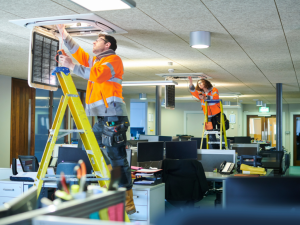
Servicing frequency for HDB aircons (BTO vs resale)
The frequency conversation splits into two by flat type, since BTO and resale flats start from different baselines. The right servicing packages for each look different too. One needs a light schedule and routine visits. The other usually needs a reset visit before settling into routine.
BTO units
A new BTO flat with aircon installed under the Optional Component Scheme starts with clean coils, fresh refrigerant charge, and a new bracket. The first 12 months can run lighter, every 4 to 6 months, since dust hasn’t built up. From year 2 onwards, the schedule becomes the standard 3 to 4 months.
Resale flats
A resale flat is the opposite scenario. The history of the unit is rarely documented. Bracket corrosion may have started, drainage may be wall-routed in the legacy configuration, and the indoor unit may not have been opened in years. A first service visit on a resale flat aircon should include a full inspection of the bracket, drainage routing, and gas charge. Often the right starting point is a chemical wash rather than a light service. The chemical wash versus general servicing comparison covers when each applies.
Here’s the practical schedule once a unit is stabilised, regardless of BTO or resale:
| HDB flat type | Typical aircon setup | General service frequency |
| 2-room HDB / studio | System 1 or System 2 | Every 3 to 4 months |
| 3-room HDB | System 2 | Every 3 to 4 months |
| 4-room HDB | System 3 | Every 3 months |
| 5-room HDB | System 4 | Every 3 months |
| Executive HDB | Twin System 3 or System 4 | Every 3 months |
There’s a seasonal point worth knowing. Aircon servicing demand peaks from May to July when Singapore’s heat is heaviest. HDB blocks see far more contractor traffic during this window. Booking in March or April avoids the rush and gets your unit ready before peak load.
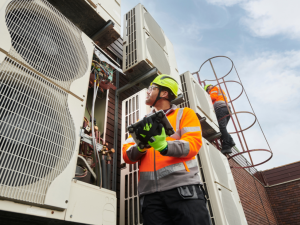
The four most common HDB aircon issues
These four cover roughly 80% of HDB call-outs handled across aircon servicing in Singapore, regardless of which contractor takes the job.
Water leakage from drainage
The most common HDB-specific complaint, almost always a blocked drainage line or wrong pipe gradient. Older flats with legacy wall-routed setups develop a slow form of this, where the gradient drifts over years and water drips down the building façade. Indoor drip-leaks stain ceilings, floors, and laminate. Catching it early during routine servicing costs nothing. Letting it run for two months turns it into a water leakage repair job involving panel removal and pipe replacement.
Bracket corrosion on the ledge
This is the failure mode that BCA cares about most, and the reason the inspection requirement exists. Singapore’s humidity and salt-laden coastal air corrode bracket fittings faster than homeowners expect. A 5-year-old bracket on a west-facing block can show visible rust at the wall mount. A 10-year-old bracket may have partial structural failure. Once the corrosion is visible, replacement isn’t optional.
Outdoor unit noise complaints
The outdoor condenser sits a few meters from the neighbour’s window in most HDB layouts. A unit with worn fan bearings, mounting that’s lost its rubber dampening pads, or a refrigerant leak forcing the compressor to work harder produces noticeably more noise. Town councils take complaints seriously, and resolving them often requires a refrigerant pressure test to confirm whether the compressor is overworked, plus a fan inspection. The noise that gets flagged is rarely from the design. It’s from a unit that has degraded.
Drainage tray algae and drip-leak combo
Singapore’s humidity feeds biofilm growth in the drainage tray. Once algae colonises the tray, the drain holes block partially, water backs up, and the tray overflows into the indoor unit body. The smell shows up first. Then the leak. By the time the homeowner sees water dripping from the front cover, it’s usually been going on for weeks. If the unit isn’t cooling well alongside the smell, the aircon not cold troubleshooting steps help isolate whether it’s drainage, refrigerant, or both.
HDB aircon noise hours and servicing windows
Two different rules get confused here. Worth separating them.
Servicing and installation work noise
This is what HDB regulates explicitly. Per HDB’s renovation guidelines, general work (which covers most aircon servicing without bracket replacement) is permitted from 9am to 6pm on weekdays and Saturdays. Noisy work, which includes drilling for new brackets, hacking for piping changes, and bracket replacement, is restricted to 9am to 5pm on weekdays only. Saturdays, Sundays, and public holidays are off-limits for noisy work. The full rules are on the HDB renovation guidelines for aircon installation page. If your contractor wants to drill on a Sunday morning to fit your schedule, that’s a violation. Town council enforcement is responsive, and a complaint can stop the job mid-drill.
Operational noise from the outdoor unit
The clock-hour rules don’t apply here. A running aircon doesn’t have permitted hours. What governs operational noise are the NEA boundary noise limits for ACMV systems, which set decibel thresholds at the affected neighbour’s property boundary. Modern inverter aircons run well below these limits when they’re maintained. A unit producing complaint-worthy noise is almost always a maintenance problem rather than a design problem.
The practical implication: schedule servicing for weekday daytime when possible. If bracket replacement is needed, weekdays only. Don’t book a Sunday morning slot for drilling work, regardless of what the contractor says.
What inspectors actually check on HDB aircon supports
This is the section most homeowners don’t know exists. BCA mandates that aircon support inspections be carried out at least every 6 months, with a trained installer doing the check during routine servicing. The BCA air-conditioning safety guidelines lay out the formal requirement.
What gets checked on a proper HDB aircon support inspection:
- Bracket material and grade. Stainless steel only. Grade 304 is the standard. Galvanised steel brackets are non-compliant for new installations.
- Anchor integrity at the wall and ledge. Wall plugs, dynabolts, or chemical anchors must show no looseness, no surface rust, and no cracking around the mount points.
- Bracket weld and joint condition. Welded joints develop fatigue cracks over time, especially on units with heavier compressors. A crack starts small and propagates.
- Concrete ledge condition where applicable. Spalling concrete, exposed reinforcement bar, or visible cracks signal a structural problem that needs town council and HDB attention, not just an aircon contractor.
- Damping pad condition. Rubber pads under the outdoor unit lose elasticity in 3 to 5 years of Singapore weather. When they fail, vibration transmits directly into the wall and into your neighbour’s living room.
- Electrical isolator at the ledge. Required for safe servicing. Should be correctly rated and weatherproofed.
For a resale flat without documentation, an inspection often reveals the bracket needs full replacement before the next installation. Older fixtures from 15 years ago weren’t always built to current standards. The aircon replacement and bracket considerations section in the broader replacement guide is useful for owners weighing whether to keep an old setup or start fresh.
There’s also Form AC-02. After any HDB aircon installation, the trained installer must submit it to HDB within 14 days. The form documents the installation, the technician’s credentials, and bracket specifications. If you’re buying a resale flat, asking the previous owner for the AC-02 record is a fair question, even if many won’t have it on hand. When the documentation gap is too wide to assess on paper, book a servicing visit that includes a full bracket and drainage inspection so you start from a known baseline.
Conclusion
HDB aircon servicing carries constraints that condo servicing doesn’t. Fixed bracket loads, mandated drainage routing to internal floor traps, town council noise rules during work, and BCA’s mandatory 6-monthly support inspections all apply. The flats that age well are the ones where the bracket gets inspected on schedule and the contractor doesn’t try to drill on a Sunday morning.
If your HDB aircon is overdue for servicing, or you’ve inherited a resale flat with an unknown maintenance history, book a proper inspection before the May to July rush. SACES handles HDB servicing across Singapore with certified technicians and full documentation. Book your HDB aircon service.
FAQ About Aircon Servicing For HDB
How often should I service the aircon in my HDB flat?
For most HDB flats running aircon 6 to 8 hours daily, every 3 to 4 months is the standard interval for general servicing. BTO units in their first year can stretch to every 4 to 6 months since dust accumulation is lower. Resale flats with unclear maintenance history should start with a full inspection.
Are there specific noise hours for aircon work in HDB flats?
Yes, but the rules apply to servicing and installation work, not the running aircon itself. Per HDB renovation rules, general work runs 9am to 6pm weekdays and Saturdays. Noisy work like drilling or bracket replacement is weekdays only, 9am to 5pm. No noisy work on Sundays or public holidays.
Does my BTO flat aircon need different servicing than a resale flat?
Yes, in the early years. A BTO unit installed under the Optional Component Scheme starts with clean coils and a fresh bracket. Lighter servicing every 4 to 6 months works for the first year. A resale flat usually needs a full inspection on first visit, since maintenance history and drainage routing are often unknown.
What does BCA actually check on an HDB aircon installation?
BCA requires aircon supports to be inspected at least every 6 months by a trained installer. The check covers bracket material (stainless steel required), anchor integrity, weld condition, concrete ledge condition where applicable, damping pad wear, and the electrical isolator. Form AC-02 records the installation specifics.
Why is my HDB aircon dripping water down the external wall?
Most likely the drainage pipe was routed through the external wall in the older configuration, which is now non-compliant under HDB rules. Current rules require drainage to discharge into an internal floor trap. Wall-routed drainage triggers town council complaints from neighbours below and should be re-routed during the next aircon installation.