
Professional aircon servicing Singapore isn’t a premium upsell. It’s what separates units lasting 8 to 10 years from ones that fail at year 4. Most homeowners don’t know what ‘licensed’ actually means. This blog will walk you through what professional aircon servicing covers, why DIY costs more, and how to vet a contractor before booking.
What “professional” actually means for aircon servicing in Singapore
Most homeowners assume “professional” means the technician shows up in a uniform and brings a vacuum. That’s marketing. A professional aircon contractor in Singapore meets four conditions, and a uniform proves none of them. The technician handling refrigerant must be a certified Refrigerant Practitioner under the National Environment Agency’s regulations. Anyone working on fixed electrical connections must be supervised by an EMA-licensed electrical worker. The business itself needs a UEN registered with ACRA. Reputable contractors also carry public liability insurance covering damage to your home or injury during work.
Beyond credentials, professional servicing produces paperwork. You should receive a written scope-of-works before the job starts and a post-service report after. The post-service report includes gas pressure readings, before-and-after observations on the indoor and outdoor units, the technician’s name and certification reference, and recommendations for the next visit. If a contractor refuses to issue this, the work cannot be verified later. When a leak appears two months on, you have nothing to point to.
There’s also the question of scope. A 20-minute “service” that touches only the indoor unit isn’t professional servicing. A proper job covers the indoor coil flush, drainage line pressurised flush, fan barrel cleaning, gas pressure check at the outdoor condenser, and electrical connection inspection. For households or small businesses with multiple units, the aircon servicing approach for homes and offices follows the same workflow, scaled to unit count and access points.
A real chemical wash, when needed, also belongs in this category. The aircon chemical wash service involves dismantling the fan coil, soaking the coil and barrel in chemical solution, rinsing thoroughly, and reassembling. Done properly it takes 60 to 90 minutes per unit. Done as a 15-minute spray-and-wipe, it’s nothing of the sort.
The real cost of DIY and bargain-bin servicing
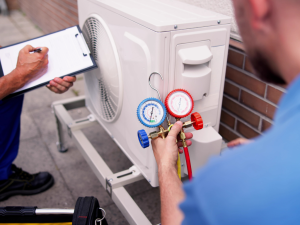
The market reality in Singapore is that “$30 aircon servicing” deals run every week on Carousell, Facebook groups, and discount platforms. The maths doesn’t add up. After platform commission, fuel, materials, and the technician’s pay split, the actual labour budget per unit is often under S$10. At that rate, the technician spends 12 to 15 minutes per unit. That’s not enough time to do a real job. The shortcut is usually skipping the drainage line flush (which is where most leakage problems start), skipping the chemical inspection on the evaporator coil, and quickly wiping the front cover so the unit looks cleaner from the outside. Three months later, the leak appears.
Refrigerant is the second hidden cost. Top-up of R32 or R410A by anyone without Refrigerant Practitioner certification is a violation under Singapore’s regulated refrigerants framework. The risk isn’t theoretical. Refrigerant exposure causes frostbite injuries on contact, and in poorly ventilated spaces it can cause asphyxiation. Beyond safety, mishandled refrigerant means incorrect charge levels, which forces the compressor to overwork until it fails. Replacing a residential compressor in Singapore costs S$800 to S$1,500 depending on capacity. The aircon gas top-up service handled by a certified technician is the only legal and safe path.
Manufacturer warranty is the third hidden cost, and the one most homeowners only discover when they need it. Daikin, Mitsubishi Electric, Panasonic, and York all include clauses in their warranty terms requiring servicing or installation by authorised parties to keep parts coverage active. The exact language varies by brand and contract, but the principle holds across the major brands sold in Singapore. A homeowner who saves S$100 on a discount service can lose access to a S$1,200 free compressor replacement two years later.
DIY chemical wash is the worst version of all this. Online tutorials make it look like a weekend project. The actual risks are gas leaks, electrical shorts, mounting bracket failure (HDB-mounted units have fallen and injured people on lower floors), and refrigerant contamination of the indoor environment. There is no reasonable DIY version. The job requires certification, equipment, and chemicals that aren’t available retail.
Credentials a licensed aircon contractor must hold in Singapore
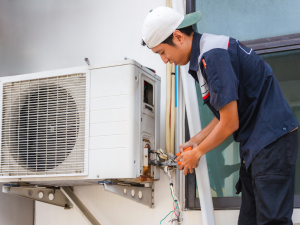
Six pieces of paper separate a licensed contractor from the cowboys. Not all six apply to every job, but you should know which apply to yours.
NEA Refrigerant Practitioner certification.
Required for anyone handling refrigerants under Singapore’s Hydrochlorofluorocarbon and Hydrofluorocarbon regulations. Training is delivered through BCA Academy. Ask for the certification reference assigned to the technician on your job, not just a generic “all our staff are licensed” statement.
EMA Licensed Electrical Worker (LEW).
Required for any fixed electrical work, including new aircon circuits, isolator switches, or modifications to your distribution box. The EMA’s guide to engaging Licensed Electrical Workers explains the LEW classes and how to verify one. For pure servicing without electrical modification this isn’t always invoked, but for installation it always is. The aircon installation service requires an LEW on the team for any new circuit.
BCA Specialist Builder licence (CR class).
Under BCA’s Builders Licensing Scheme, the CR class covers Air-Conditioning, Refrigeration and Ventilation specialist works. This applies to commercial projects above defined contract values and government-tendered work. For HDB residential servicing, this licence is generally not required, which is why the popular search “BCA aircon installer” doesn’t map cleanly to one document. The phrase usually refers to a contractor whose technicians are trained at BCA Academy and certified as Refrigerant Practitioners. The two schemes are connected through BCA Academy but they aren’t the same licence.
ACRA UEN registration.
Every legitimate contractor in Singapore has a Unique Entity Number registered with ACRA. You can verify any UEN, registered business name, address, and director on ACRA’s BizFile portal. Cash-only outfits without a UEN aren’t worth the risk on a job that touches fixed wiring or refrigerant.
Public liability insurance.
Reputable residential aircon contractors carry S$1 million to S$2 million in public liability cover. This protects the homeowner if a unit is dropped during installation, water damage occurs from a botched drainage line, or a technician is injured on your property. Ask to see the policy summary or insurance certificate. Real contractors send it on request.
Brand-authorised servicing status.
Daikin, Mitsubishi, Panasonic, and York each maintain authorised dealer networks. If your unit is under warranty, brand-authorised servicing is what keeps the warranty alive. For aircon replacement and warranty considerations, confirming brand-authorised status is the single most important credential check before booking. Authorised dealer status is published on the brand’s official website, not just on the contractor’s marketing.
How to vet a contractor in 15 minutes before booking
Five questions to ask. Two documents to request before you hand over a deposit. If a contractor stalls on any of these, that’s the answer to whether you should book.
Questions to ask
- Are your technicians NEA-certified Refrigerant Practitioners? (Ask for the certification reference for the technician assigned to your job.)
- Do you carry public liability insurance, and what’s the coverage amount?
- Are you an authorised dealer for the brand of my unit? (Cross-check on the brand’s official website.)
- What’s the exact scope of works for the price quoted?
- Will I receive a written post-service report?
Documents to request before paying a deposit
- A written quotation listing every service item, parts, and price (GST-inclusive)
- A copy of the public liability insurance certificate or summary letter
If the contractor responds quickly, with specifics, and without pushback, they’re probably legitimate. If the response is “all our technicians are licensed don’t worry about the paperwork”, find someone else. Compare quotes against realistic aircon servicing Singapore market rates. A typical general servicing visit for a System 3 setup falls in the S$60 to S$120 range, depending on contract versus one-off pricing and whether chemical wash is involved. The general aircon servicing pricing context breaks this down further. Anything significantly below market usually means the contractor is cutting scope, skipping documentation, or both.
What a legitimate scope-of-works and post-service report look like
These two documents are the difference between accountability and a verbal promise. They also determine whether you can claim under warranty if something goes wrong six months later.
A scope-of-works document includes
- The exact services to be performed per unit (filter wash, fan barrel vacuum, evaporator coil rinse, drainage line pressurised flush, gas pressure check)
- Estimated time per unit
- Parts to be replaced, if any, with itemised prices
- Total quoted price, GST-inclusive
- Date of service and the assigned technician’s name
A post-service report includes
- Date, start time, and finish time
- Technician’s name and Refrigerant Practitioner certification reference
- Gas pressure readings before and after work, where refrigerant was touched
- Visible condition of the indoor unit, drainage line, and outdoor condenser
- Photos of before-and-after where relevant
- Recommendations for the next service or follow-up repair
- Warranty terms applicable to the work performed
If a contractor hands you a one-line invoice that says “aircon servicing, 3 units, paid”, you have no record. When the unit leaks two months later, you have nothing to argue with. Reputable Singapore contractors issue both documents as standard practice. Asking for them upfront also signals to the contractor that you’re paying attention.
Conclusion
A licensed contractor with proper credentials, insurance, written scope-of-works, and a post-service report costs marginally more upfront. They cost dramatically less over the life of the unit. Most aircon failures I see in homes that switched contractors trace back to a discount service that skipped scope, mishandled refrigerant, or quietly voided a manufacturer warranty without telling the owner.
Before your next booking, run the four-credential check and ask for the scope-of-works in writing. When you’re ready to book SACES servicing, SACES handles HDB, condo, and small commercial servicing across Singapore with certified technicians, full documentation, and transparent pricing. Speak to the SACES team about your aircon servicing.
FAQ About Professional Aircon Servicing Singapore
What makes aircon servicing “professional” in Singapore?
A professional aircon service in Singapore is performed by NEA-certified Refrigerant Practitioners working for a contractor with an ACRA-registered UEN, public liability insurance, and brand-authorised dealer status if your unit is under warranty. The work is documented in a scope-of-works upfront and a post-service report after.
Do I really need a licensed aircon contractor for routine servicing?
For pure servicing without refrigerant work, the strict legal requirement is lower. The moment refrigerant is handled, NEA Refrigerant Practitioner certification is required. Since most servicing visits include a gas pressure check at the outdoor condenser, in practice you do need a licensed contractor for almost any visit beyond a basic filter wash.
Can DIY aircon servicing void my manufacturer warranty?
Yes, in many cases. Daikin, Mitsubishi, Panasonic, and York all include clauses requiring servicing or installation by authorised parties to keep parts coverage active. DIY work, especially anything involving refrigerant, modification, or installation, typically voids the warranty. Check your specific warranty card before opening anything.
How do I check if an aircon contractor is registered in Singapore?
Use ACRA’s BizFile to verify the contractor’s UEN and registered business name. Check EMA’s licensee portal for the named Licensed Electrical Worker. Ask for the technician’s NEA Refrigerant Practitioner certification reference. If the contractor refuses to share any of these, treat that as your answer.
Is the cheapest aircon servicing Singapore option ever a good idea?
Almost never. A “$30 servicing” deal leaves under S$10 for actual labour after platform fees, fuel, and materials. That buys 12 to 15 minutes per unit, which is enough to wipe surfaces and not much else. The drainage line flush and gas pressure check that protect the compressor get skipped.